Eva Hess – Chechu Álava
Last January the Thyssen-Bornemisza installed the temporary exhibition Rebeldes to showcase a series of paintings by Spanish artist Chechu Álava, which celebrates “the imaginary life of ancient myths and the experience of eminent women in the modern age.” The series as a whole is a commentary on and challenge to the patriarchal structure of museum institutions as they exist today. To that end, the artist adopts a unique and characteristic “hyperfeminine style” to call attention to the artistic qualities that have over time drawn scorn and disdain from misogynist critics. The paintings themselves are gentle, atmospheric, and in some cases dream-like. Each one is a portrait or depiction of talented, creative, and powerful women – all creators – including women such as Simone de Beauvoir, Hannah Arendt, Sylvia Plath, Frida Kahlo, Marga Gil Roësset, etc. The painting I chose to highlight is a portrait of the German-born American sculptor Eva Hesse. Painted as a 27 x 35cm oil on canvas, this painting caught my eye initially because of the slightly disproportionate, uncanny representation of the subject as she reclines on the divan. The features of the subject, coupled with the artist’s delicate technique, evokes a feeling of disorientation akin to a dream-like state in which you encounter a familiar relation (close friend, family member, etc.) and watch them slowly morph into someone distinctly unfamiliar (yet still recognizable) over the seemingly timeless progression of the dream. There are no hard edges in this painting. Every element within the frame is soft and muted, leaving room for the eye to swim through the canvas and absorb the subdued energy it contains.
-Brett Stolpestad
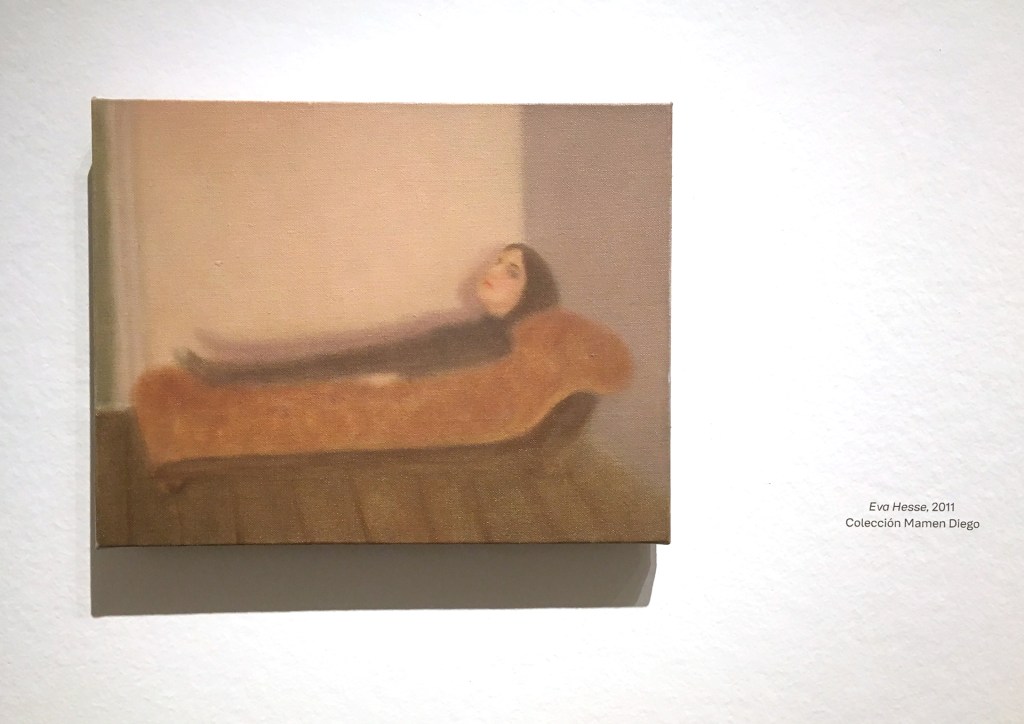
Eva Hesse by Chechu Álava, 27 x 35cm, oil on canvas, Mamen Diego collection 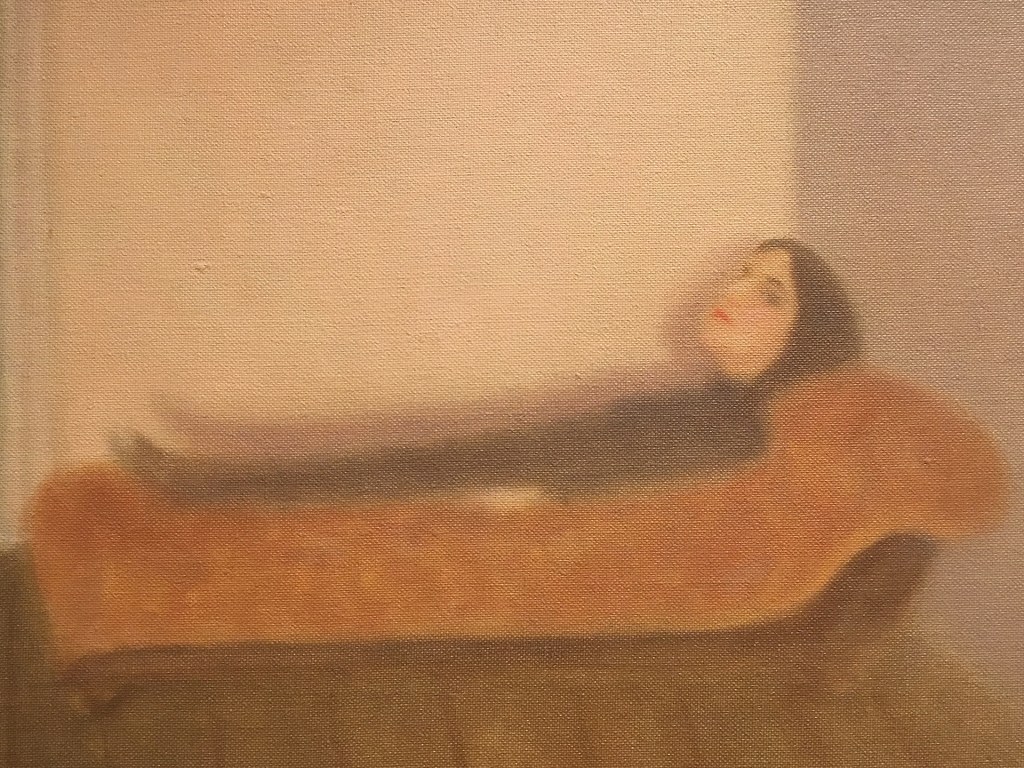
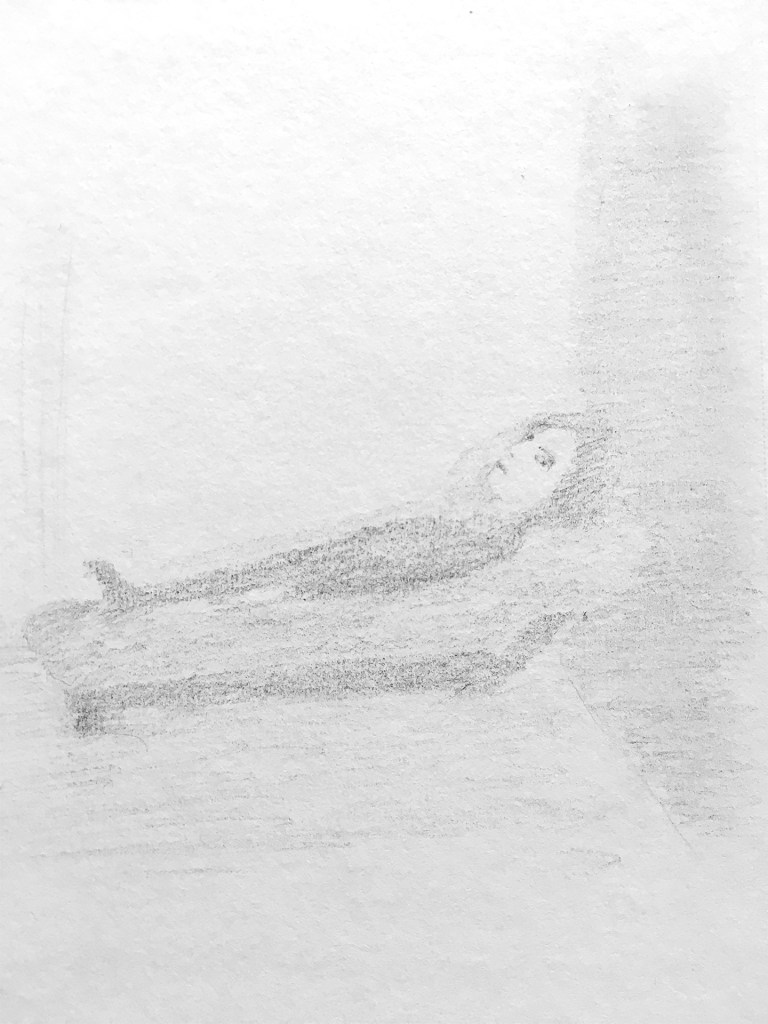
Attempt to emphasize/represent the artist’s painting technique with simple tonality.
Before going to the Thyssen Bornemisza Museum I looked up the work that they had. The artist I was looking forward to seeing was Salvador Dali, my favorite artist. Unfortunately their Dali collection wasn’t there for some reason.
Instead, I did find multiple paintings of St. Anthony Falls. I immediately knew the work from multiple research projects. I love the broad landscape that both Bierstadt and Lewis portray in their paintings. Both paintings push the scale of the falls back in space by placing a large tree in the foreground. They also play with scale by putting a person near the edge of the cliffs.
There is a strong contrast between the two paintings due to the tree canopy. In the one by Lewis there is no foliage. This then allows him to open up the sky, which makes the scale of the falls seem smaller than the Bierstadt one. Though they are painted by different people, they both capture the essence of the once roaring falls. Also, they both show the destroyed Spirit Island that was sacred to the Dakota people.
The other work that I really enjoyed seeing was the Jackson Pollock. Brown and Silver is one of his most well known works and is the only one the museum had of his. The painting evokes energy and movement, from large erratic brush strokes. Brown and Silver gives a nice contrast to the still art of portraits and landscapes that fill most of the museum.
The collection at Thyssen Bornemisza is small in comparison to the Prado. That said, I believe it to be more manageable for an afternoon. The layout of the work also seems to make more sense, they are categorized and rooms force you through in a direction and cadence. It is much more palatable.
-Jordan Hedlund
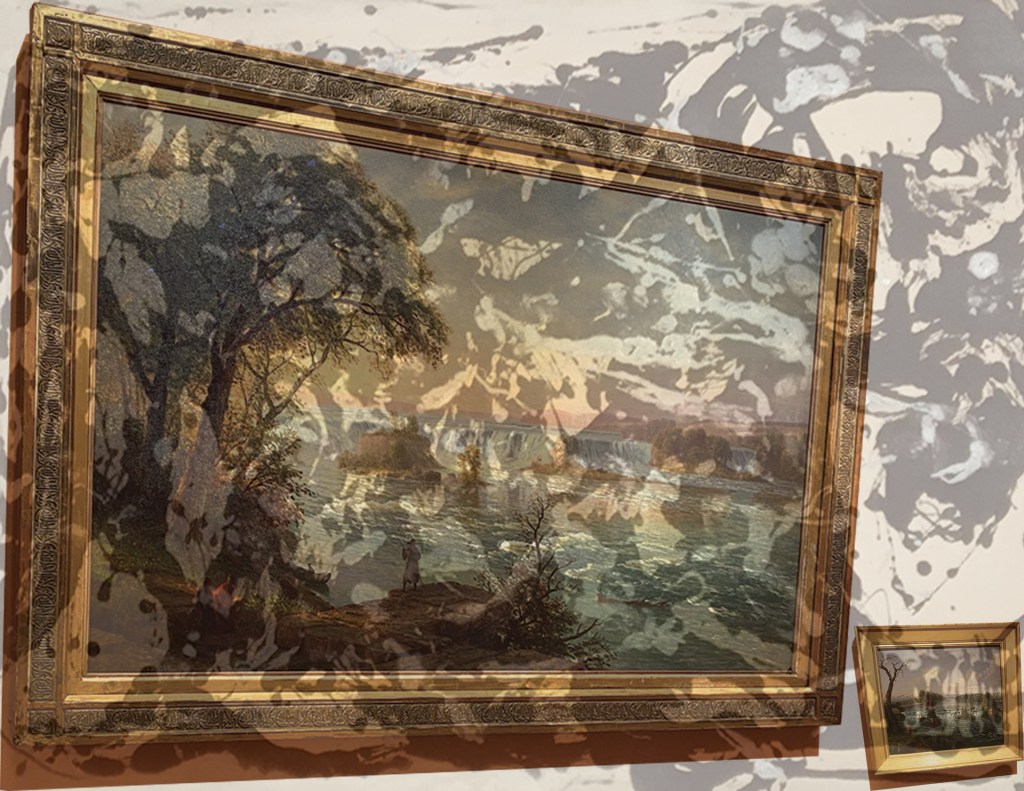
contemporary Brown and Silver over images of St. Anthony Falls paintings
Émile Bernard, “Women Bathing”, 1889, oil on canvas
At the Thyssen-Bornemisza, I was initially drawn to “Women Bathing” by French painter, Émile Bernard, because of the composition of figures in the painting. I noticed that some of the eight women shown in the work take on such modest poses, holding their hand or towels in front of them as they approach the water. Adding to the sense of reserve, the three women approaching the water are all looking down or away. One woman has her back to the viewer entirely. Other women are in the water already; one in particular takes on an unashamed pose. Another woman on the land looks at herself in the mirror. In the figures I see a tension between modesty and immodesty. Beyond the people, objects are nearly indecipherable. Exception: there are trees with what appears to be exposed roots and a two lily pads in the water. In the background there is a tree. Most of the land in the painting is a shade of dark yellow that grabs my eye and keeps it there. Color is the second reason this is my favorite artwork. The arrangement and choice of color I find pleasing, especially where the dark blue meets the large swath of yellow earth. Unifying the figures and objects is the artists consistent use of vertical brush strokes throughout the painting. Between the figures and the objects/colors is the third reason this is my favorite piece: black outlines. These outlines are part of a small movement started by Bernard and others called Cloisonnism. Cloisonnism breaks from its contemporary movement, Impressionism, through isolation of objects rather than blurring the lines between them. It is characterized by these contours, which removes emphasis on perspective and space (1). In Bernard’s words, his goal was “to highlight the abstract sense and not the objective” (2).
1. https://www.museothyssen.org/en/collection/artists/bernard-emile/women-bathing
2. C. Spretnak, “The Spiritual Dynamic in Modern Art: Art History Reconsidered, 1800 to the Present”
-Kendra Klenz
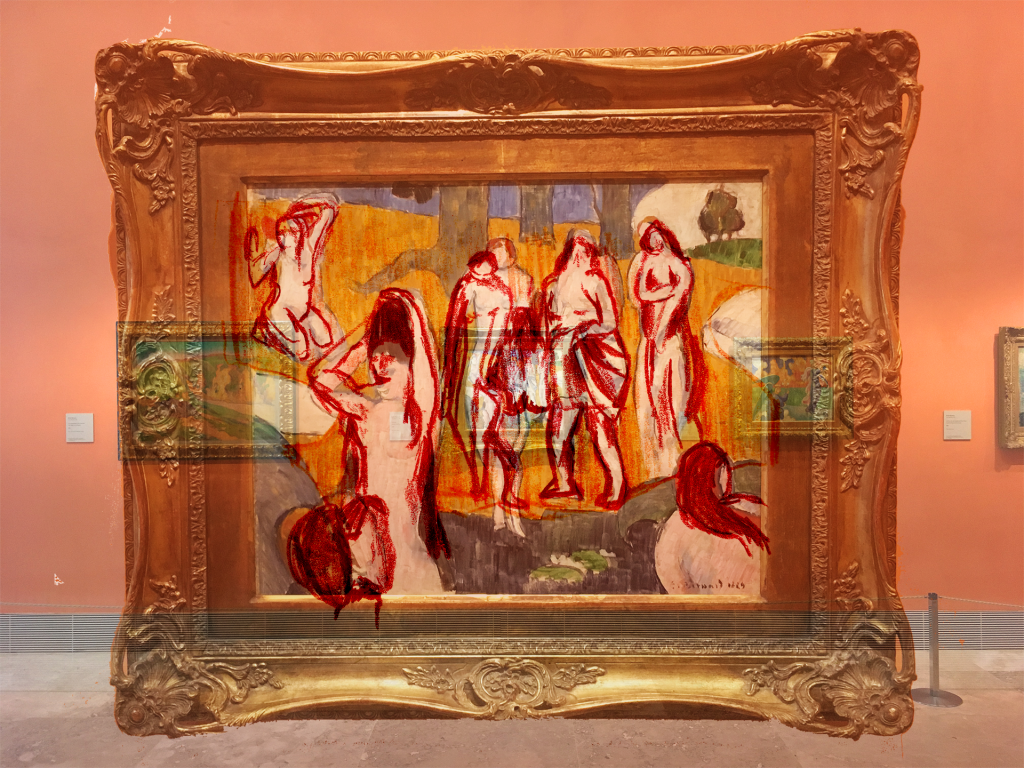
image of women bathing in its frame. Figures and yellow color in painting emphasized through added hand drawing. 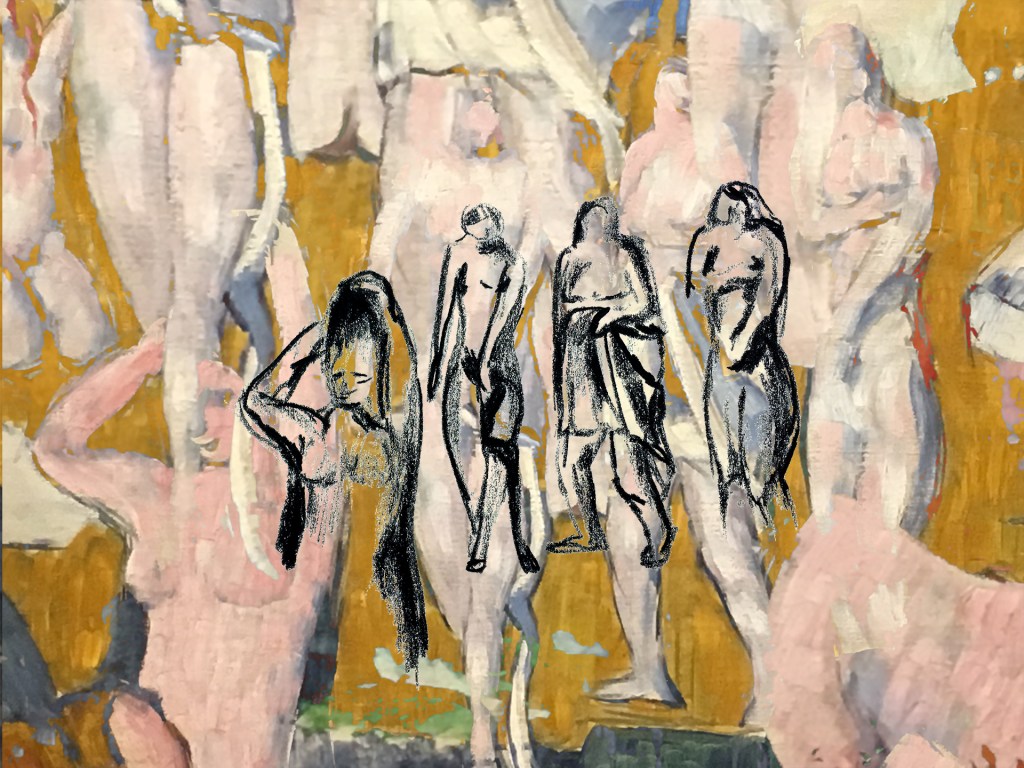
image of four of the women. The three on the right have modest postures while the woman on the left, in the foreground, does not. 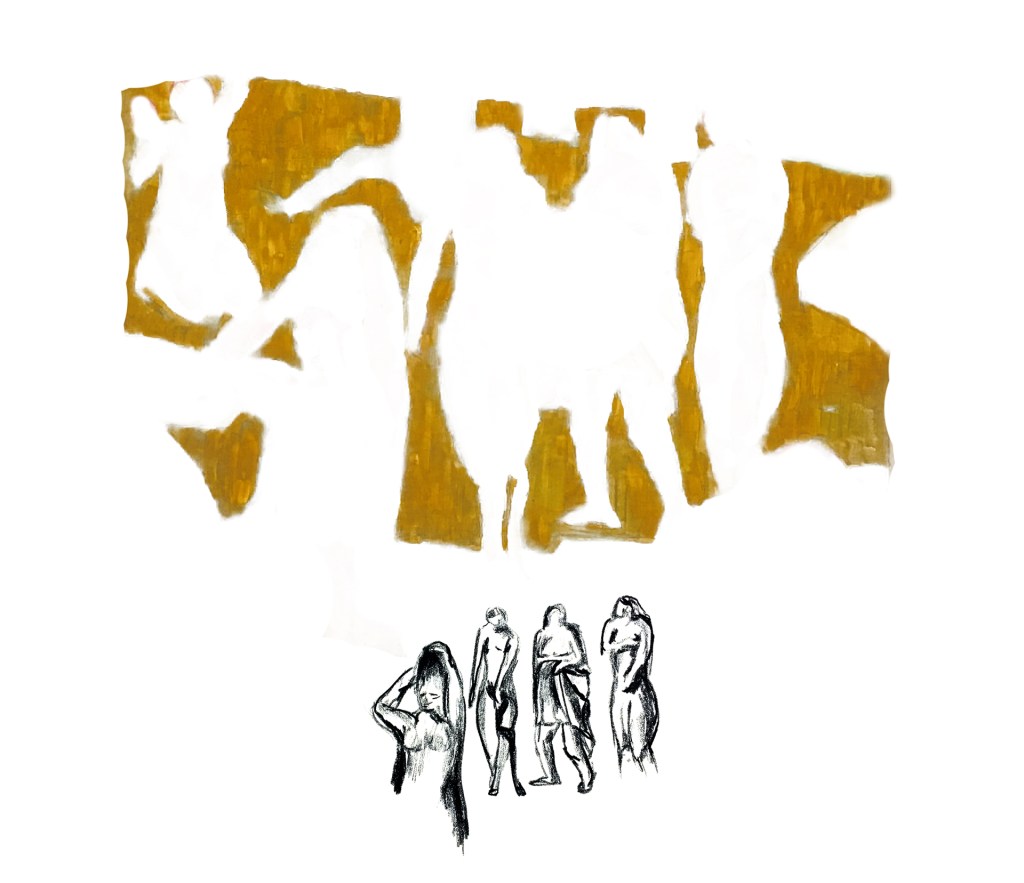
image of the yellow part of the painting only paired with a drawing of some of the figures that take up the negative space in the yellow. Look closely. 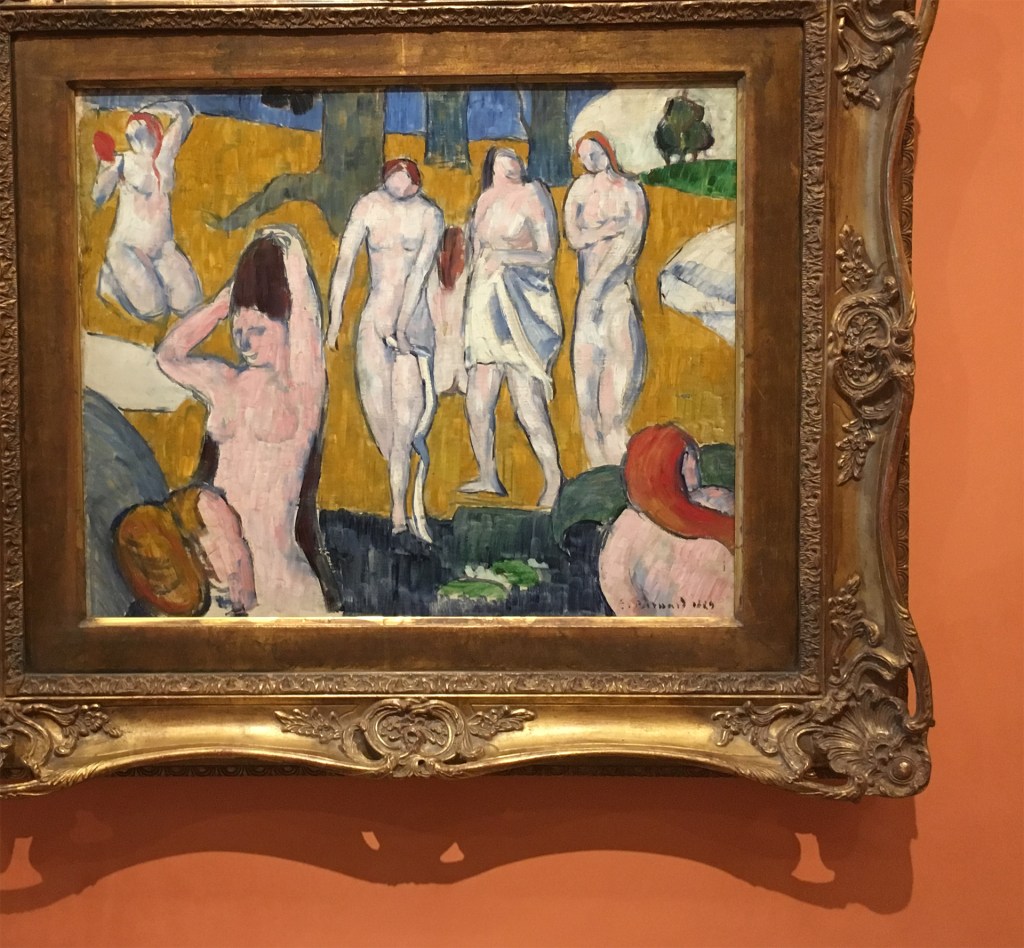
image of painting on display
“Brown and Silver l,” by Jackson Pollock
Today we went to the Thyssen-Bornemisza Museum. It was there that I discovered a work of art created by Jackson Pollock. It was truly different from anything I had witnessed previously at other art museums like the Museo del Prado, and the Reina Sofia. The work I saw of Pollock’s was called, “Brown and Silver l,” which was created in 1951. The piece is comprised of a tan canvas with black and silver paint drizzled, splattered, and brushed on it in very organic and incongruent ways.
The technique Pollock employed was called “action painting,” which involved placing the canvas on the ground, and very dynamically, maneuvering around the canvas as he applied paints of varying sizes, proportions, consistencies and colors to different areas. He also didn’t use conventional tools, which seemed to add a lot of character to his painting by physically altering the way paint would fall onto the canvas. He created rhythms with aerial brush strokes that were not in contact with the canvas, and simply by utilizing different tools, paints, and gravity, he was able to tap into the potential of that separation.
Black paint was cast in large swaths on the canvas, and silver paint was applied over top of that, which added great depth to the painting, while also emphasizing how lines may be used without clear determinacy. An eye would not naturally focus on any one point of the painting due to this technique, however the virtue of such a skill was the ability to create art that would allow the mind to interpret shapes to any degree of detail. I found immense pleasure in interpreting the shapes as elements that would mix to create the universe.
-Collin Wenberg
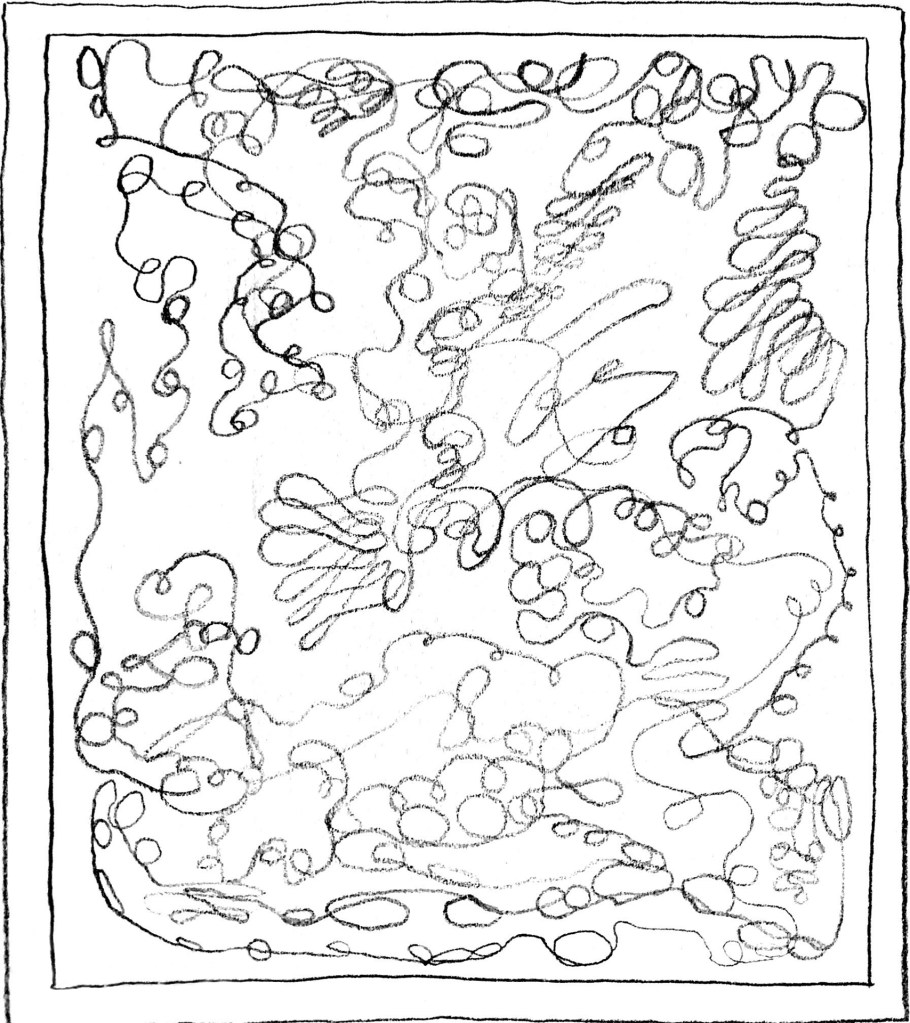
Continuous Line Graphite Representation of Jackson Pollock’s, “Brown and Silver l.”
Somehow – exactly 4,457 miles away from Alexandria, Minnesota – I was home. I wasn’t searching for home, I wasn’t thinking about home, but as I stumbled upon John Frederick Kensett’s piece, “Lake George,” I was transported. Transported to a cool, crisp morning on Lake Latoka, maybe in early May. My mom and I are the only two awake in the house. We tip-toe around the kitchen to the patio doors, each grabbing a mug of coffee before sneaking outside.
The wood planks are still damp under our feet from the morning dew and creak below us as we find our way to the outdated rocker. It is when we sit and look out toward the lake that we both find our bliss. The sun is peaking over the trees in the east, and its reflection flickers over the ripples in the water. The loons in the bay are singing their song as the nearby fisherman patiently waits for a bite. We sit in silence, slowly sipping our coffee as the rest of the world awakens. I hold these memories closely as I continue my adventure abroad.
Of course, Kensett’s piece was not of Lake Latoka, but it evokes feelings and emotions that allow me to be there. Kensett represents Lake George, a large freshwater body located in the Adirondack Region of New York. He paints a naturalistic, wild scene of the historically significant lake. The soft strokes and desaturated colors utilized by Kensett allow the viewer to have a tangible and sensual experience. Fleeing birds in the foreground of the scene bring the stationary landscape to life. However, it is not his technique or his precision or his color palette that makes Kensett’s work so special – or really any artist’s work in my opinion – but it is how the work can impact the viewer. And today, “Lake George” was the most impactful piece that I had personally experienced.
Thank you John Frederick Kensett – today you brought me home.
-Rachel Peterson
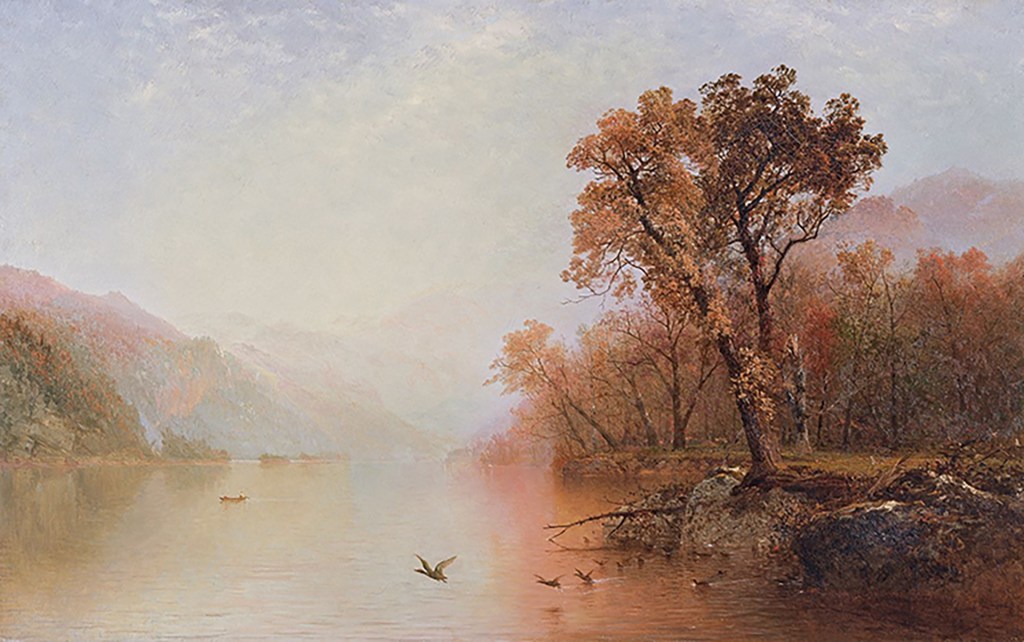
John Frederick Kensett’s “Lake George.” 
View from porch at Lake Latoka. 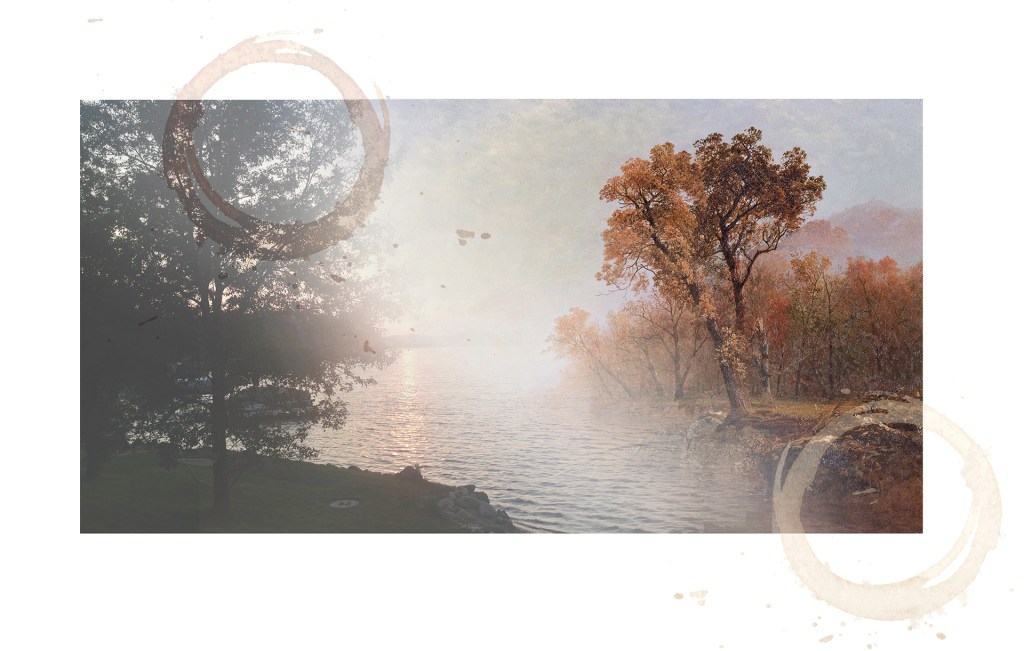
Transported Home.
Rayonism: Perceiving Life through Light
Our world is perceived through light and shadow. The reflected energy of light cast back by every surface around us provides not only the basis for vision, but also the platform upon which a new Russian avant-garde movement known as Rayonism was created.
Among the first paintings displayed after entering the Museo Thyssen-Bornemisza, the sense of warm light and depth conveyed by The Forest captures the gaze. Closer inspection reveals intense texture – the artist’s brush is evident in every stroke and the canvas comes alive. A prismatic glow radiates from the center, illuminating a slight figure that emerges from the depths of the forest. In the canopy overhead, birds glide on beams of light across the scene.
Founded on the principle that we can never actually see an object but are instead beholden to a source of light in order to make sense of our surroundings, Goncharova (an original creator of Rayonism) utilizes a set of rays – appearing as a series of overlapping fractured and splintered brush strokes – to create her imagery. Gonacharova strove to represent the dynamic nature of vision and perception by highlighting emerging science and theory – going as far as to pen the Rayonist Manifesto. Given that we can only perceive the rays of light reflected from an object that enter our field of vision, it is fitting that this scene is depicted as a series of reflecting beams.
-Marla Brown
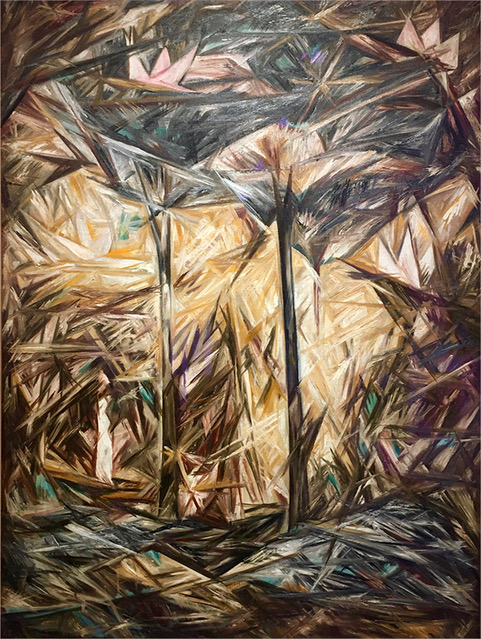
Painted in 1913, The Forest marks the beginning of a new Russian avant-garde movement: Rayonism. The Rayonist Manifesto, written and signed by
Natalia Goncharova and her partner Mikhail Larionov in 1913, explores the nature of vision and light.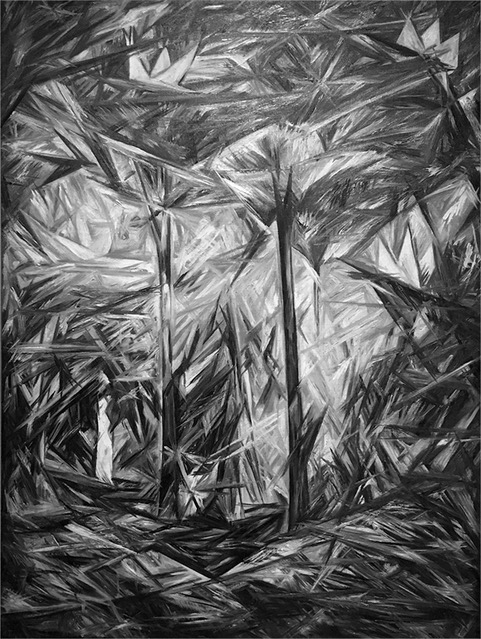
Conversion of The Forest to black and white exposes the artist’s expression as rays of light. We can clearly see the fractured light converging toward the center, creating a sense of depth and space in the forest. 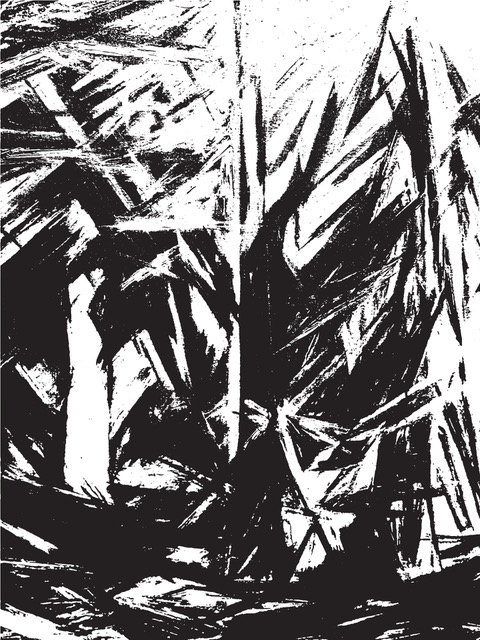
Abstracting the image yet further to examine the contrast between pure light and dark, the brush strokes splinter into a jungle of illumination and shadow – illustrating the artist’s ideas about how we see and perceive the 3-dimensional world around us.
My experience with Mark Rothko’s Untitled (Green on Maroon, 1961):
Situated among other abstract paintings by Clyfford Still and Morris Louis of similar size, this piece is easy to walk by. Unassuming, until you pause. Set against gallery-white walls, the painting appears deceptively simple. The large canvas fills your vision; it is a maroon rectangle, taller than it is wide. A green rectangle of a similar value, though wider than it is tall, is nested in the top half of the canvas. Careful layering. Variations of opacity. Brush strokes not obvious, only the changes in density of paint material. Any potential strategy apart from color division is undefinable. I find it fascinating that it is a piece unassociated, which is a pleasant experience after the barrage of Madrid daily life.
The strength of the visual effects shoves aside other sensory experiences that allow for recognition of the gallery space. The rapid passage from the outer world to Rothko’s is quiet. In this introspection is an unknown space and unknowable dimension, the transitions like a stop-motion horror in the way of the movie Coraline. The abstraction of this Rothko feels vaguely threatening. The piece joins the cannon of the sublime with other abstract artists. Abstract art has always had a relationship to the sublime, especially in response to the confusion of modern life in a world capable of world-war atrocities, which remains relevant now in the contemporary awareness of the self-destructive behavior of humanity. It presents a dichotomy with providing a feeling of discovery, but not always clarity. Building from the Gothic and Romantic traditions, it explores the turbulent and spiritual of existence, especially in relation to the natural and physical world. In this case, division from the reality of the gallery. For me, this particular experience reminds me of the gothic novels of Ann Radcliff, known for her ability to explain the supernatural found within the natural aesthetic; or the dark, descriptive prose of Joseph Conrad’s The Heart of Darkness; and also the revealing existential narration of Chinua Achebe’s Things Fall Apart. For everyone, this piece would arouse different connotations. In this way, viewing Rothko’s piece is an introspective experience that sits deep in the sublimity of visual echoes.
The experience of looking: Relax focus.| The green square disappears, and the entire canvas turns to black. The outer and inner rectangles fight for space, one growing larger as the other is forced smaller and vice versa. Vacillating. Calming and unsettling. |Refocus. Relax focus.| A dark smudge infects the rest of the canvas with its darkness. The top edge pulses electric blue. |Refocus. Relax focus.| The green square darkens and unfolds over and over and over until it engulfs the canvas. |Refocus. Relax focus.| The green smudge smokes and covers the canvas again in inky black. The fight between the inner and outer commences again as if inevitable. The rectilinear versus the organic. |Refocus. Relax focus.| The green rectangle turns black once more, but this time goes deeper and darker; black, blacker, black hole, edges spark, race, vibrate. |Refocus. Maroon and green back in the Thyssen.
-Erin Schregardus
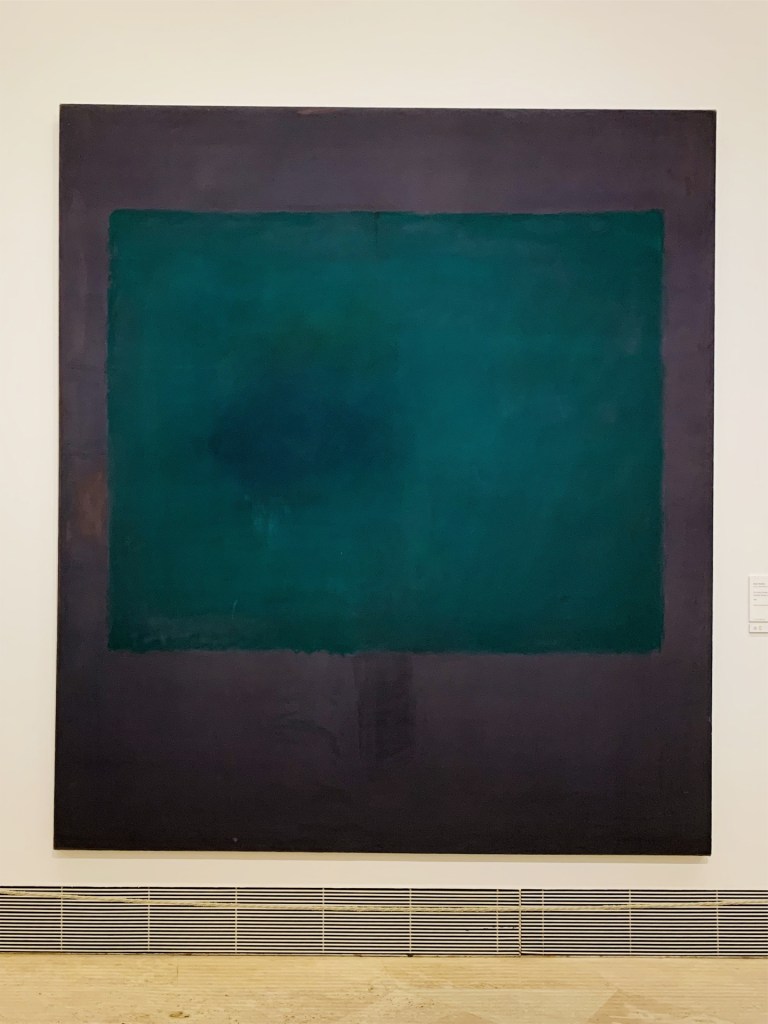
Original artwork by Mark Rothko: Untitled (Green on Maroon), 1961. 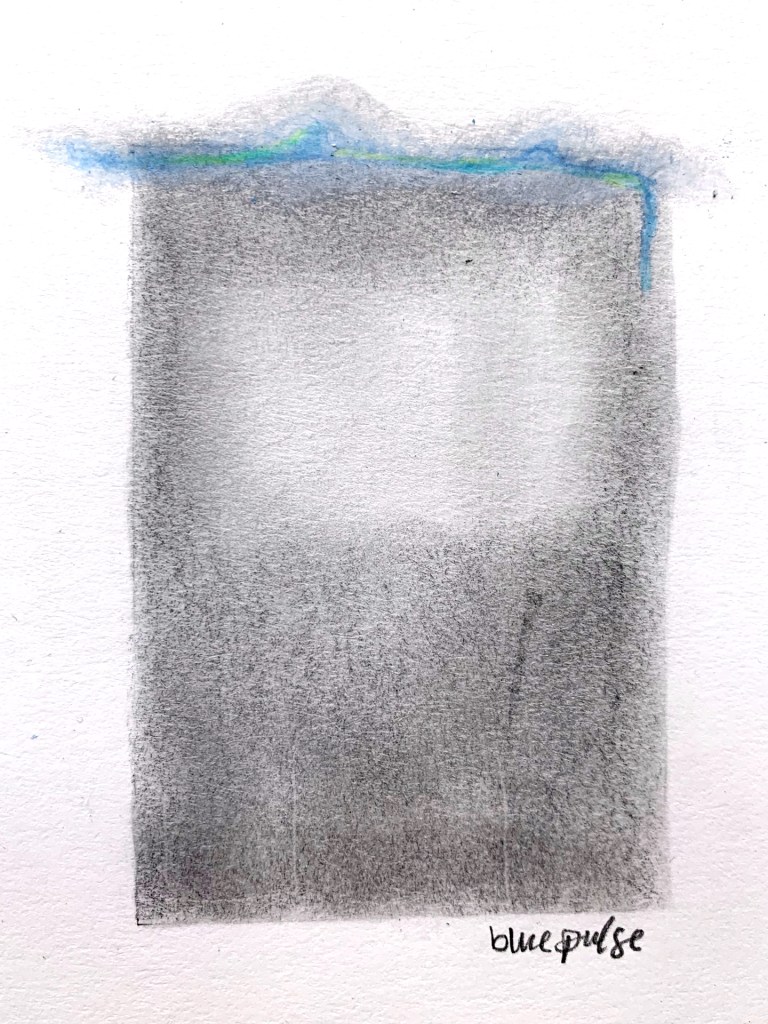
Experience sketch: “top edge pulses electric blue.” 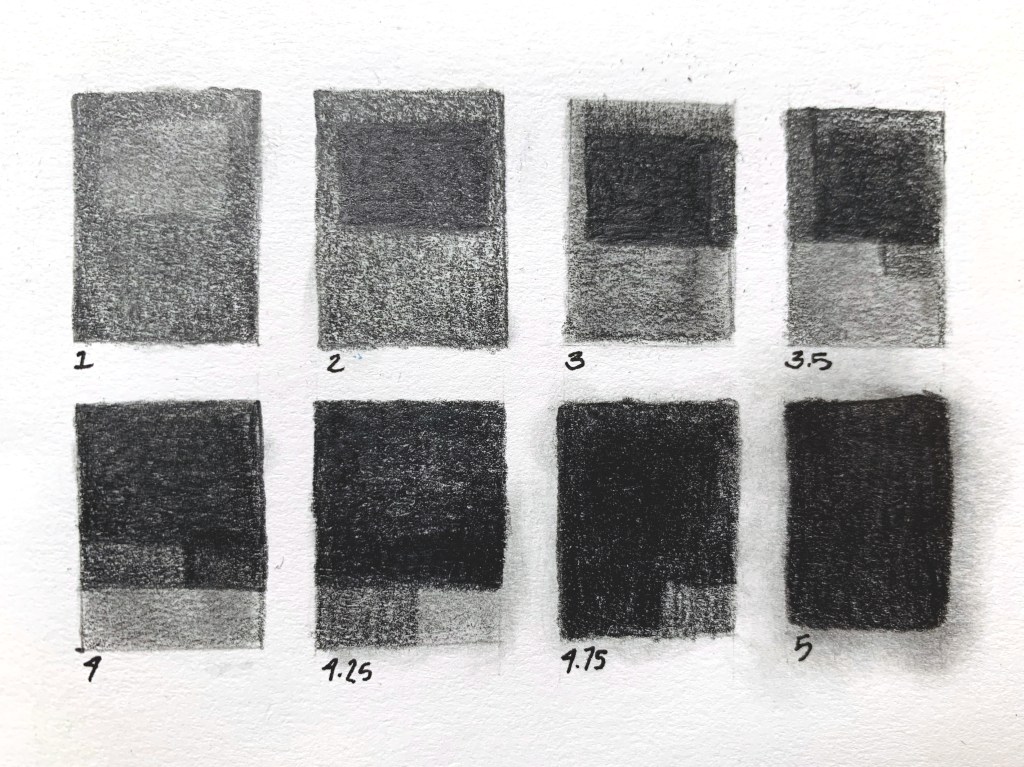
Experience sketch: “the green square darkens and unfolds over and over and over.”
The piece I chose to highlight following our visit to the Museo Nacional Thyssen-Bornemisza was done by the well-known Georgia O’keefe. New York Street with Moon is certainly not her most famous work, as her flowers and soft renditions of cow skulls come easily to mind. As I walked through the gallery, I was stunned by such a gentle, other-worldly representation of a city.
Buildings of New York are not soft like this painting makes them out to be, and therefore it did not coincide with my own internal assumptions about tall buildings and cities. But, in this internal dialogue I realized that defined shapes and sharp edges are what we are taught to perceive, but may not be what we wish to see.
Curious about the painting’s origin story, I found that O’keefe wished to exhibit her feelings towards New York City, rather than represent it visually. She did so even after being told that the work would never sell as “even men found it difficult to paint New York skyscrapers”. So why was her representation so successful? Perhaps simply due to its stark contrast to what we see, or, perhaps it goes to a deeper level. We have long associated tall, rough skylines as centers of masculinity and power, but what if we made a complete disassociation between these structures and their constructed purpose and treated them as sculpture just for one moment? Perhaps we could perceive the landscape as Georgia O’keefe did and understand a more gentle existence, or at the very least, imagine another world while still living in this one.
-Lauren Arndt
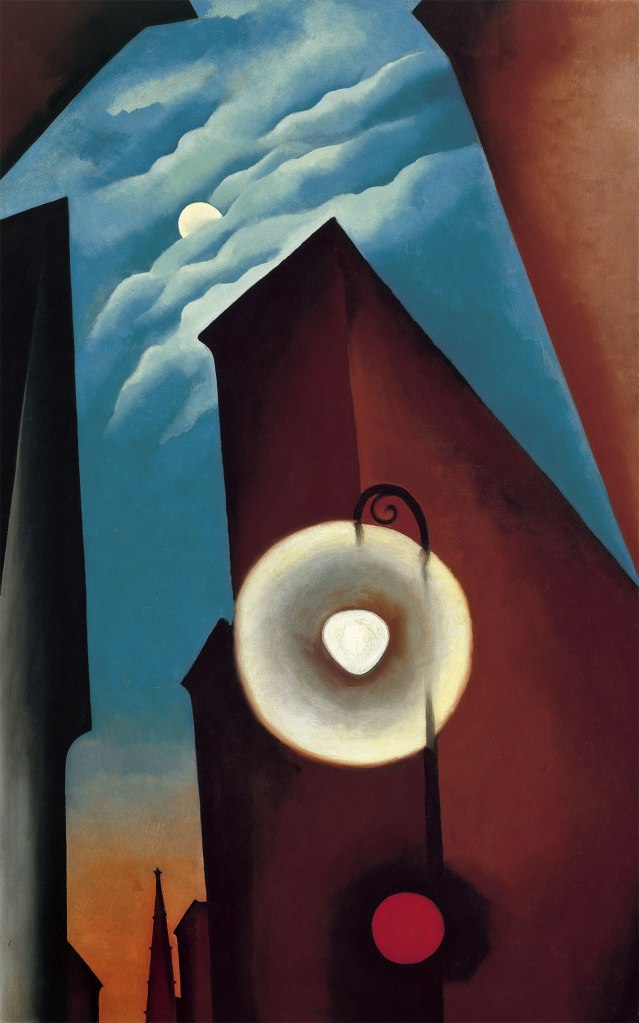
New York Street with Moon, Georgia O’Keefe 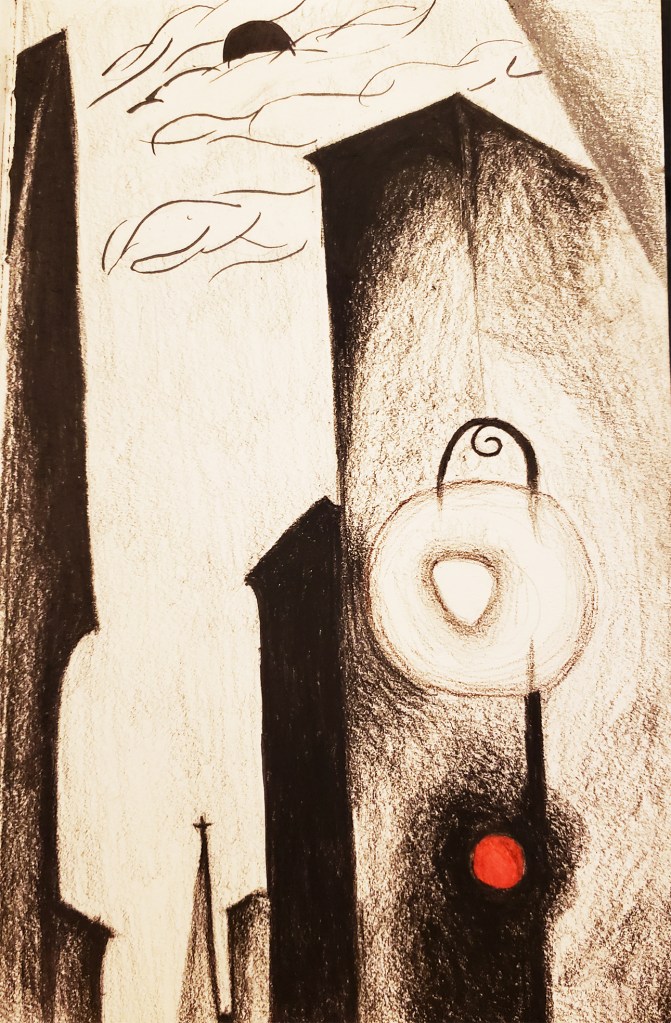
Charcoal/Marker representation of New York Street with Moon, Georgia O’Keefe
Max Ernst painted Solitary and Conjugal Trees in 1940. The stark landscape can not be situated in time and reveals a mysterious world that is both forgien and familiar. This tension and hybridinity is what attracted me to the painting. Strange colorful monoliths rise up from a flat uniform ground plane decorating an otherwise empty world. Yet, running between the vertical towers is a singular path, distinct in color and materiality from the surrounding homogeneity. There are clues scattered throughout the painting that contextualize the surrealness so as to draw the viewer into a continuous spiral of recognition and anomalousness.
The phenomenon is repeated in the bizarre textures and colors of the vertical spires. Their scale and spatial arrangement do not resemble anything of this world, yet, when closely inspected, several human faces reveal themselves as if carved into the material. Was this landscape constructed? Are the faces relics of some past civilization? There is a desertedness to the scene that provokes one to enter into it and bear witness to its weird beauty. For all its peculiarness, the landscape still has a horizon line, the sky is blue with wispy clouds, and there is a half moon hovering in the heavens. Ernst masterfully blends these understandable elements with that of the grotesque and fantastical. The hybrid nature of the landscape is inspiring to think about in terms of landscape architecture. How can a space be designed to feel wild or feral while at the same time exhibiting clues to the intentionality of the designer? What emerges when the balance is struck between the legible and enigmatic?
-David Hedding
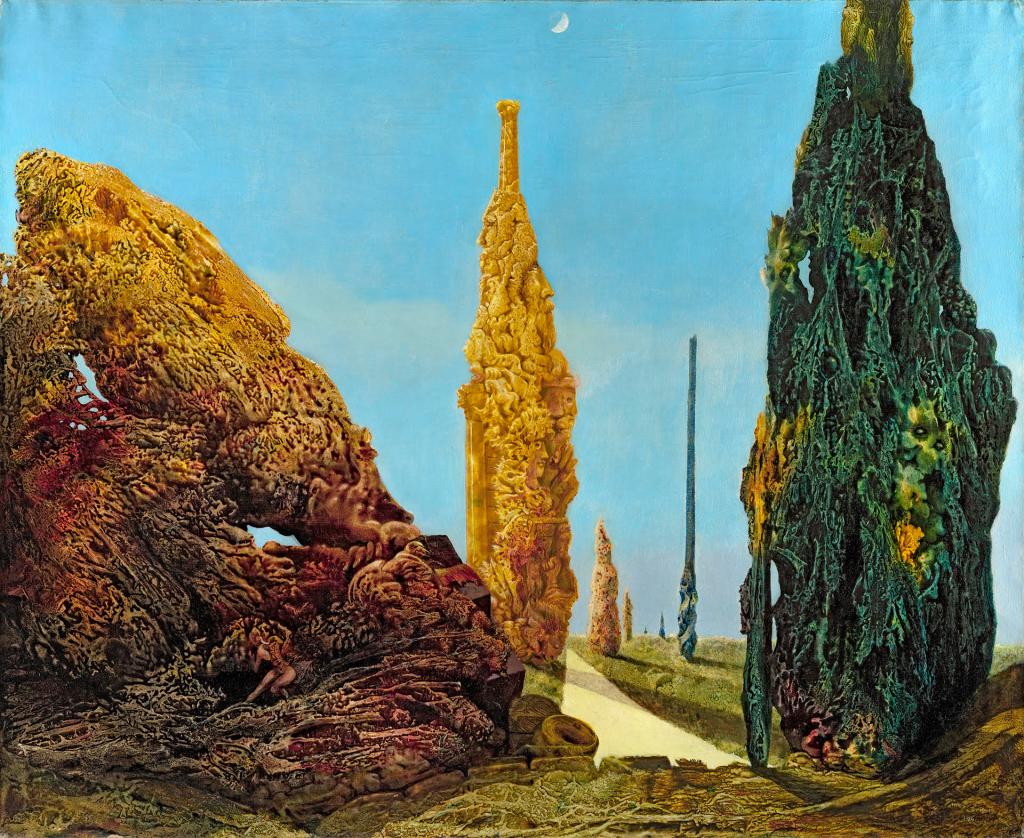
Solitary and Conjugal Trees by Max Ernst (1940) 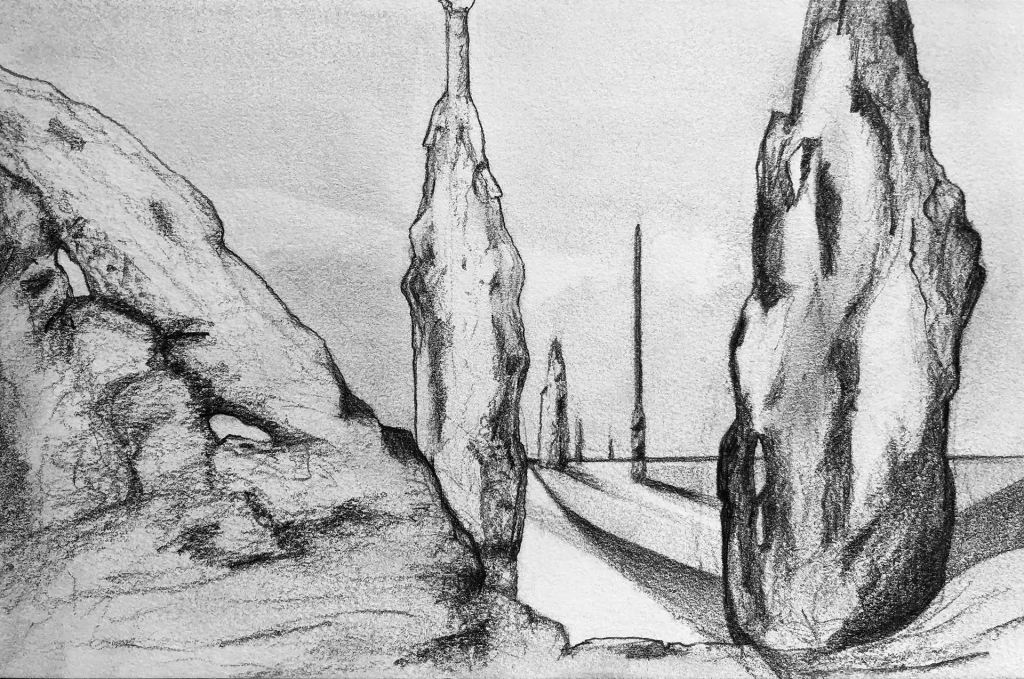
Graphite drawing done at the Thyssen-Bornemisza museum while studying the painting. 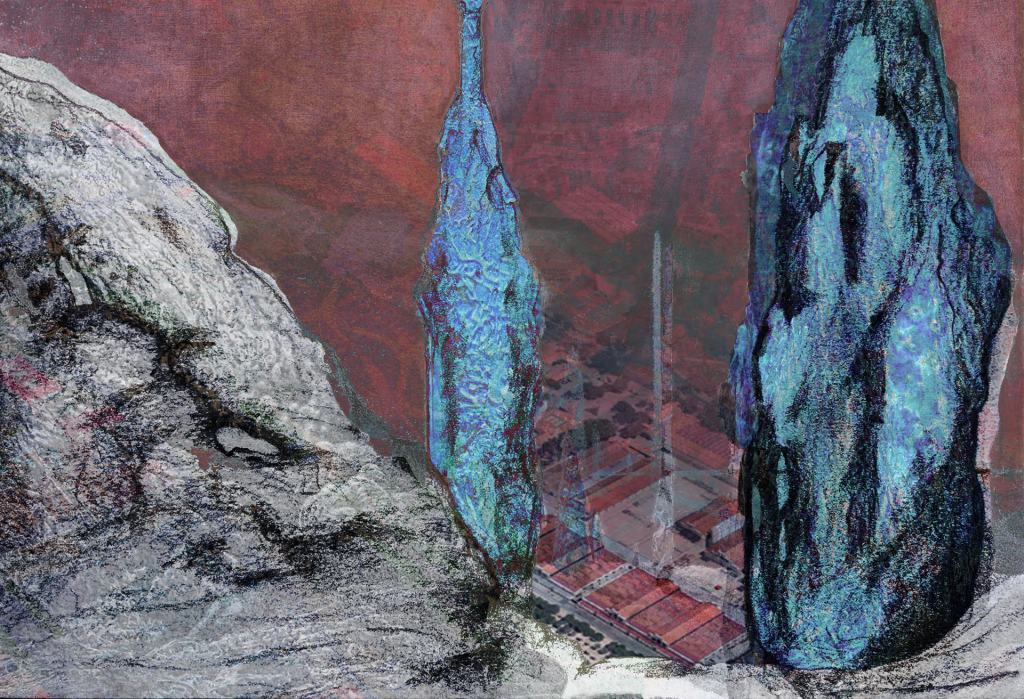
Collage of future landscape at the Matadero Madrid site where columns of water punctuate the city’s architecture.
The Museo Thyssen Bornemisza contains one of the world’s foremost and distinguished private art collections. In my visit to this museum, my attention was drawn to a painting titled “The Cock,” painted by El- Gallo in the 18th century among the extensive collections. Immediately I looked at the art. I saw a lady embracing a cock, at her feet two people embarrassing each other, on the water two people embracing as they row a boat, and under the Cock an animal that seems to be in motion. The painting also has a canopy spreading through the top of the canvas with some trees and shrubs on the sides, which appears to create an intimate space.
Throughout the history of humankind, cocks have drawn attention from different cultures and religions for the various symbols attached to them. As a rule, a cock is considered a symbol of the sun and the heavenly fire. Like the sun, he counts down the time when he crows, which signifies a new day has come. In France, he is considered a sacred bird in Gaul (a name given to the French ancestors by the Romans) due to their irritable and quarrelsome character.
In this painting, the lady embracing the Cock seems to be content that her safety is guaranteed on his back. At the same time, the two people under him seem to have no worries either. The two people who are rowing a boat are holding each other tightly, but despite being on the water, they seem content. Looking at all these instances, a Cock provides a feeling of power and vigilance. The painter has also used scale to bring out the superiority of the point of focus, which is the Cock. In addition to this, the tree canopy as well as the shrubs, bring out a sense of enclosure and protection at the same time.
-Chris Ototo
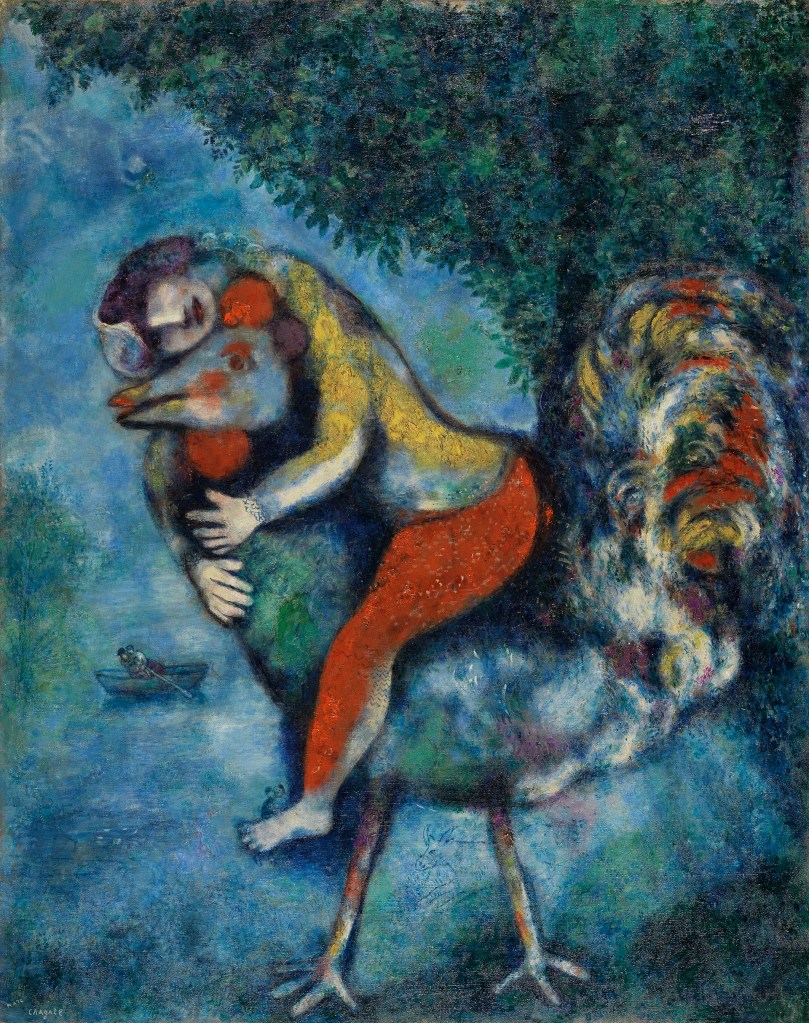
Painting By El- Gallo ” The Cock” 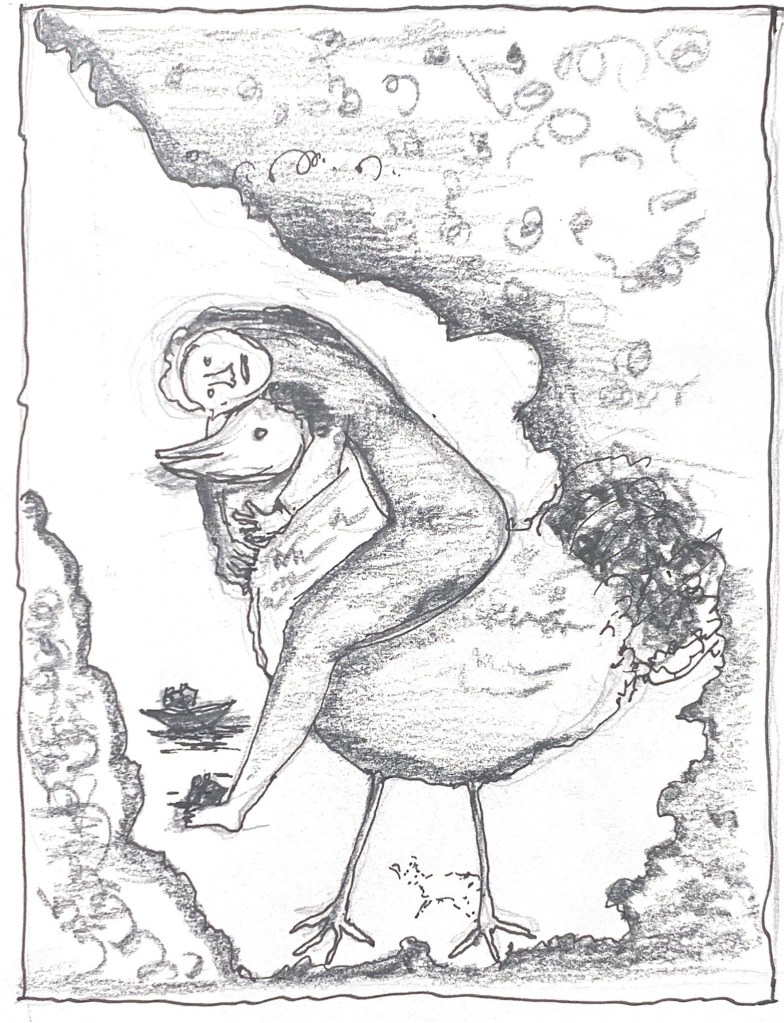
Pencil and Pen picking out the key components of the painting
The painter Umberto Boccioni, one of the cosigners of the 1910 Technical Manifesto of Futurist Painting, decided to take up sculpture, making use of assemblage – a three-dimensional collaging of objects. During 1913 his work became singularly geared to the dynamism of forms as an idea that inspired his sculptures along with a series of paintings on the premise of “Dynamism of the human body.” As can be seen from his ink drawing on paper in the Thyssen-Bornemisza Museum, Umberto Boccioni disallowed the depiction of movement through the repetitive sequence of images, and rather based his art on the perceptive investigation for the one single form which produces permanency in space. His work titled Dynamism of the Human Body: Boxer – a pen drawing on paper – departs from Boccioni’s typical three-dimensional media, but seeks to convey a similar story of movement and motionlessness, temporality and spatiality.
The drawing depicts a boxer, representing the subject amid a state of stillness and motion. The angular geometry of the linework juxtaposed against hooked, bowed, and arced pen strokes suggest movements of quick jabs and jukes, a certain swiftness amongst a clearly recognizable rigidity. The drawing also implies the muscular form of the subject’s body through the use of simple contouring and restrained shading. A few lines project to the observer a rather telling gestural story. The work stands to put forth the search for a form that is caught between spatial and temporal realms.
Much like the themes characterized by the drawing itself, I began sketching Boccioni’s work with rigidity seemingly taking over me, but soon gave way to quick gestures of the pen and a sort of freeness that came only after loosening my hold on an ill-conceived notion of attempting perfect replication. Boccioni’s Dynamism of the Human Body series celebrates gesture and abstraction, and expresses how two-dimensional media can still evoke change over time. This message promotes the observer to not be caught in the perfection of detail but rather to embrace fluidity and looseness.
-Kyle Franta
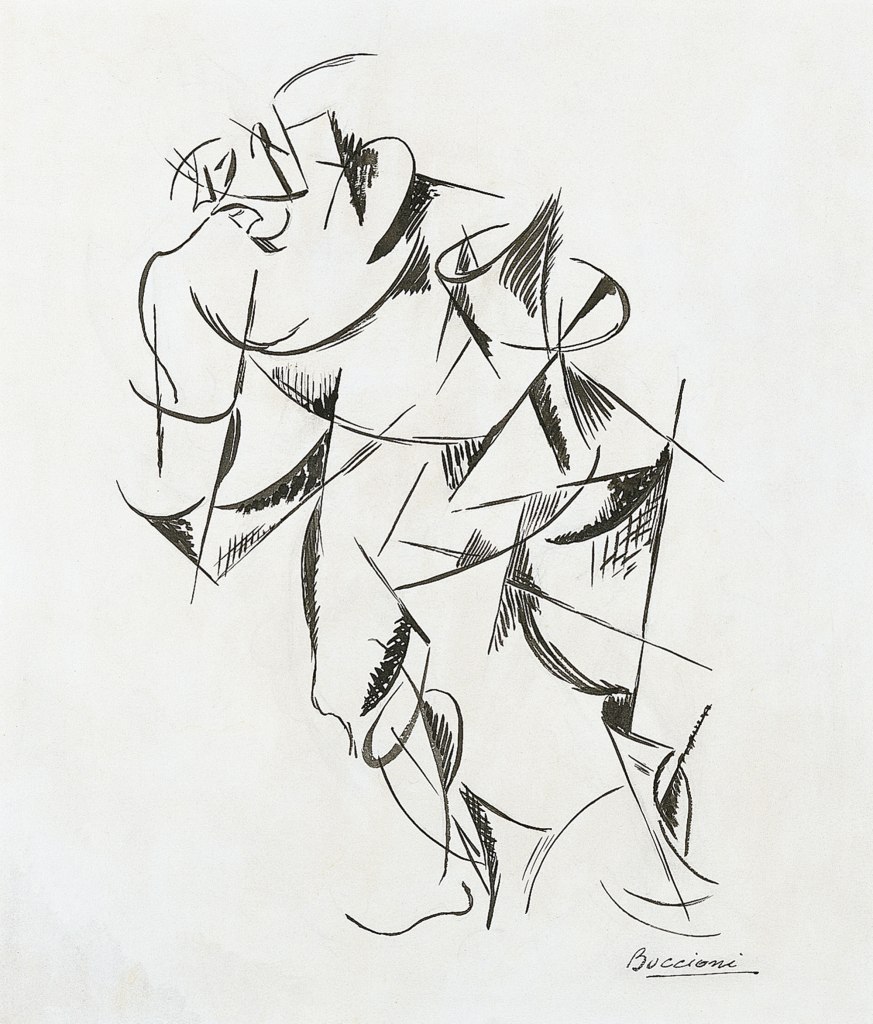
Original Artwork by Umberto Boccioni: Dynamism of the Human Body: Boxer, 1913. 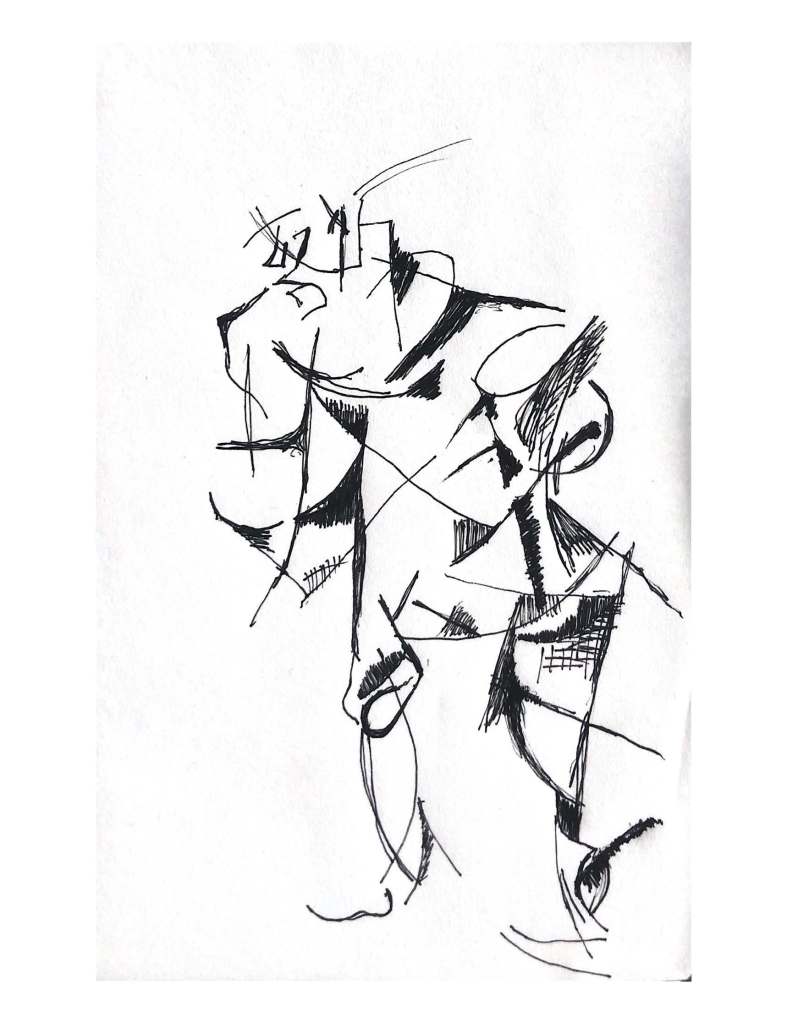
Sketch of Umberto Boccioni’s Dynamism of the Human Body: Boxer.
If landscape is truly a figment of our minds (as it is neither an ecological distinction nor do I think it carries any political weight), then I think Joan Miró paints landscapes of the heart. In campesino catalán con guitarra, deep, waving-blue hosts a delicate, rural figure and his tools: a guitar and maybe a pipe. The light linework and distinct, primary colors used sparingly are emblematic of the native catalonian painter. In the museum, this painting sticks out next to two other paintings by Miró like an ocean that you visited in your sleep one time, maybe. The guitar strings pierce through the painting – I feel like they pierce me. And I can hear them playing or breaking or testing what music is or was. The blue invites you to dive into the dream. To dance. Or to be old and remembering childhood or just other times or new times. I find the subject choice for this painting to paint more than the painting can or needs to. I can smell the earth and the nighttime where the farmer could be playing his guitar. The bright fire light from the pipe takes you nearer to him. I feel like he’s probably singing about sadness in both his heart’s landscape and his home’s. Miró paints stars like the ones in the top right corner of this painting regularly. This time, I find the relationship to the pipe striking. How small and how universal is this moment? I think he’s holding his soul physically in his body. Maybe the hat is just a physical counterbalance to the emotions he’s carrying in his belly. Just like his pipe counterbalances his song.
-Sonali Devarajan
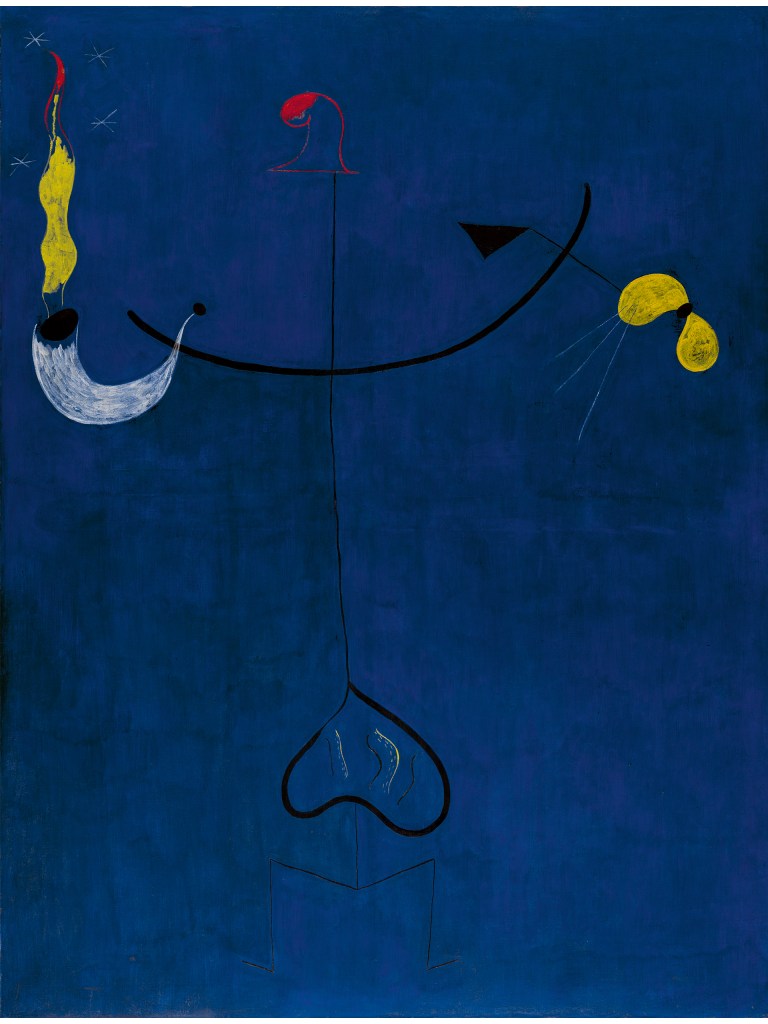
Campesino catalán con guitarra, 1924, Joan Miró. 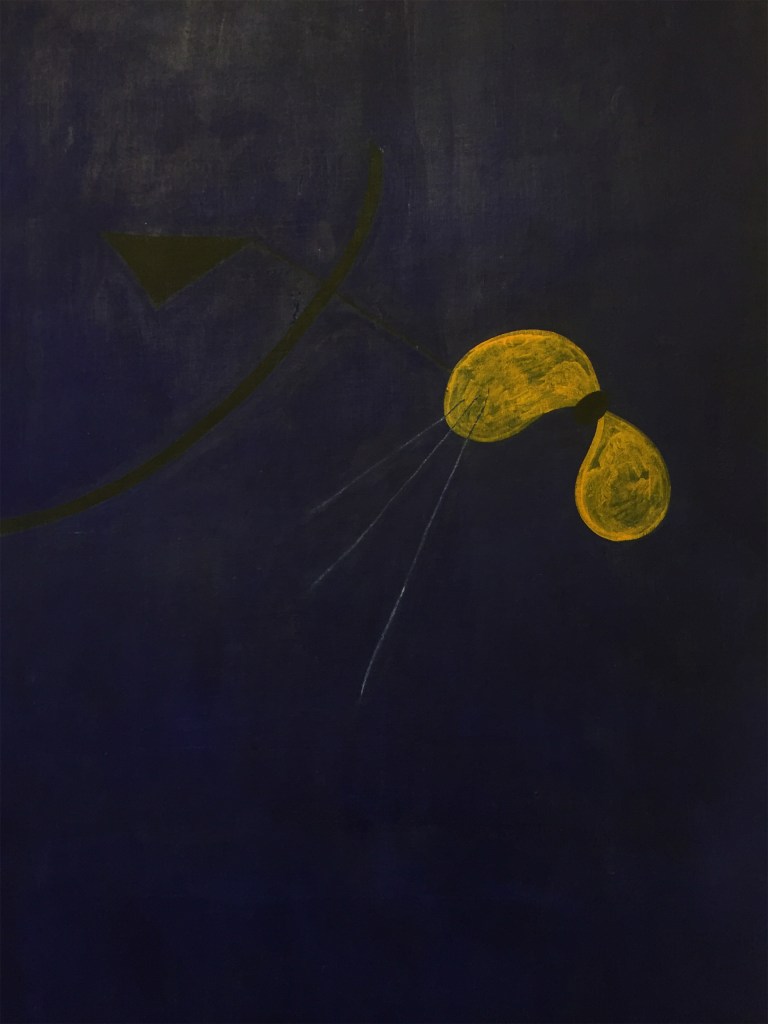
Guitar detail 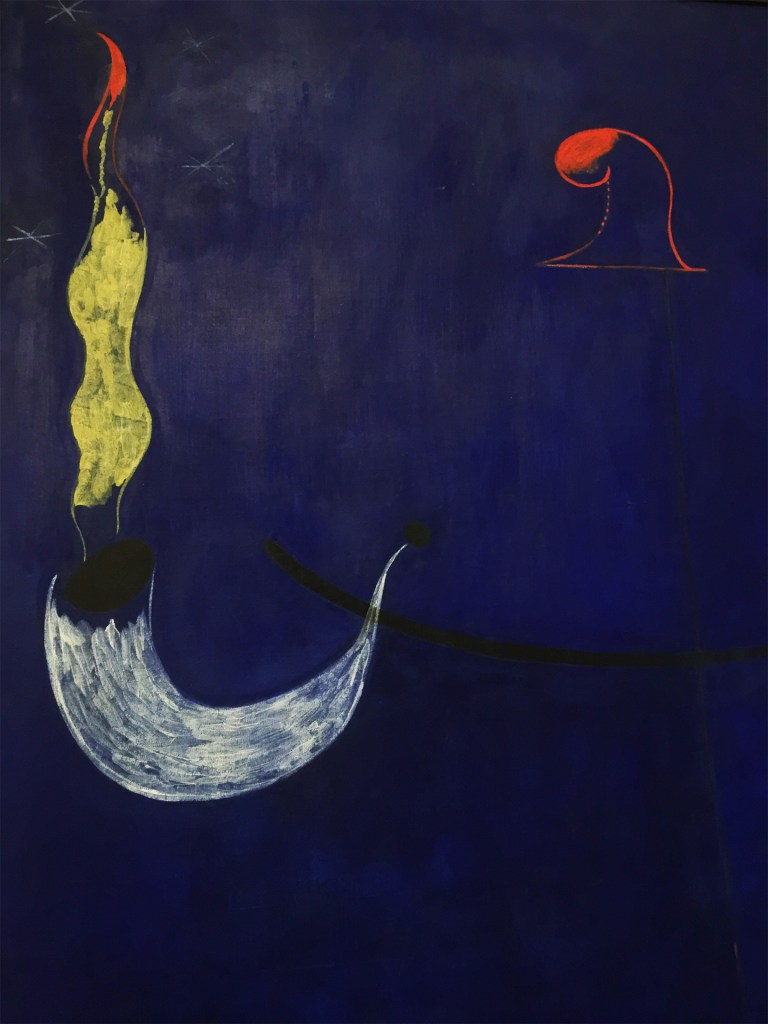
Pipe detail 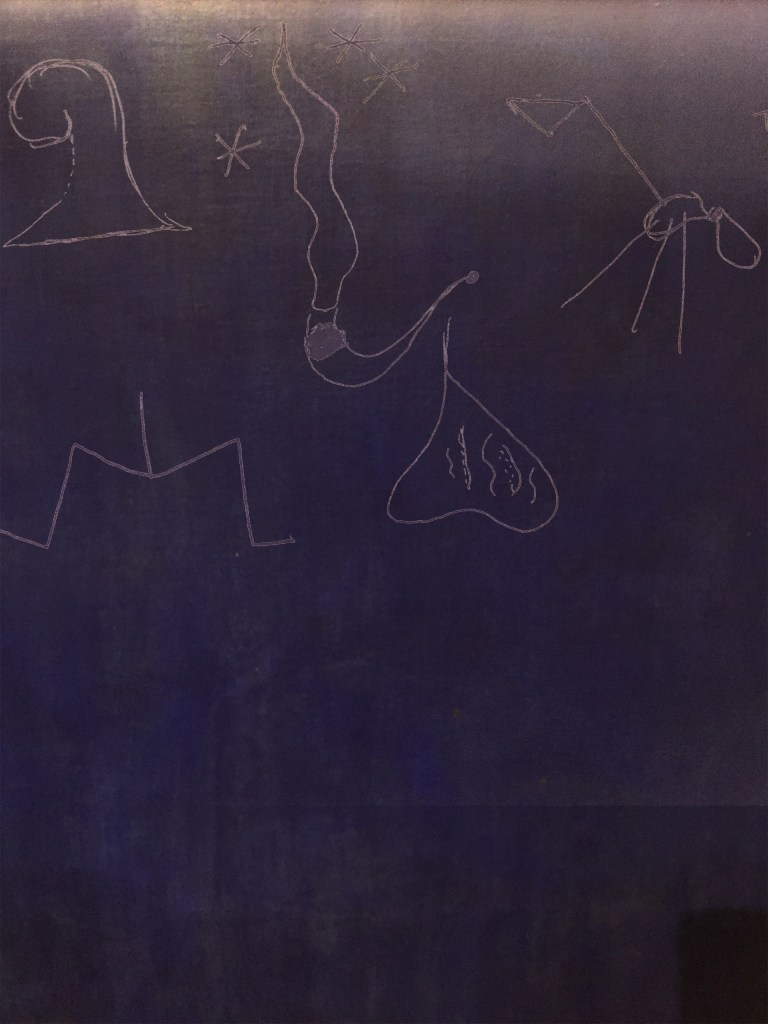
Campesino constellation

