The City History Museum of Madrid is housed in an impressive baroque building located within the city’s energetic and eclectic neighborhood of Malasaña. Originally opened as the San Fernando Hospice in the mid-17th century, the building now hosts a collection of historic maps, paintings, models, sculptures, photographs, and artifacts that trace Madrid’s history back to its formation as the nation’s capital.
In 1561, the Habsburg King Philip II decided to move the royal court from Toledo to Madrid in order to secure a central economic and political hub for the country, making Madrid the de facto capital of unified Spain. It is here where our tour of Madrid history began as we were led once again by the brilliant and occasionally tangential, Pablo Carbajosa.
At the beginning of the 16th century, Madrid was still a predominantly medieval city with narrow, crooked streets and just a handful of landmark buildings. The House of Habsburg, which ruled from 1516 to 1700, made only half-hearted attempts at urban planning during their reign, despite the construction of the San Fernando Hospice, the Conde-Duque Barracks, and the Royal Palace. This sluggish and seemingly aimless process of urbanization was countered sharply by the era of enlightenment and “embellishment” under the Bourbon Dynasty in the 18th century.
The Bourbons came to power in Spain through the ascension of Phillip V, the great grandson of Philip IV (former king of Spain and Portugal) and the grandson of Louis XIV (the sun king). Then Bourbons remained in power for the better part of the 18th century, during which time the city of Madrid assumed a distinctive “veneer” that conformed to French architectural, and even societal, ideals. It was under Bourbon rule when iconic buildings such as the National History Cabinet (now the Prado Museum), Royal Botanic Garden, the General Hospital (now the Reina Sofia Museum), and Astronomical Observatory were constructed.
The beginning of the 19th century was marked by an intense and bloody war with the French under the leadership of Napoleon. The Spanish managed to push the French out by 1813, leading to the restoration of the Bourbon dynasty through Ferdinand VII. Ferdinand VII would be a disaster, however, and an apparent continuation of the most despised aspects of the Ancien Régime. The remaining two thirds of the 19th century would be marked by drastic shifts in political structure, leading to the deposition of Isabel II (Ferdinand’s daughter), followed by a short-lived republic, followed again by the restoration of the Bourbon Dynasty through Alfonso XII as a constitutional monarch.
The city of Madrid expanded considerably in the 19th century, particularly in the later years. The population boomed from just over 281,000 in the 1850s to nearly 500,000 by 1900. Streets were widened to accommodate new transportation networks, additional housing was developed to shelter the swelling population, and new public infrastructure – such as Canal Isabella II – was built to support the city’s growing “industrious” economy.
The last few rooms of the museum showed mid-19th century photographs of demolition and construction at the Plaza del Sol, roadwork along main thoroughfares, and large public infrastructure projects. Another series of photographs showed images of new industries in Madrid, including the Matadero slaughterhouse. Paintings, photographs, clothing, and other artifacts showed what it was like to live in an increasingly liberal, yet stratified society.
Madrid would change even more rapidly in the 20th century but unfortunately this is where our tour had to end. As Pablo noted at the beginning of the tour, the museum “leaves us at the gates of the 20th century,” a century in which the country would experience its greatest tragedy, followed by its most celebrated rebirth, and extensive period of growth.
-Brett Stolpestad
Another walk with Pablo Carbajosa is another stroll through the chronicles of Madrid’s rich and often complicated history. This time, Pablo leads the class through the Museo de Historia de Madrid, his rich knowledge flowing outward and landing here or there, guiding us on a journey through time. Pablo knows his history, there is no denying that. He wonders when someone will finally write the story of Madrid like they did for Barcelona, and I wonder why he doesn’t take the role on himself.
As we slowly work our way through the museum we take in the people, places, artifacts, and tales that represent the history of Madrid, if only a small, often idealized part of this story. I wonder who’s stories are told, and whose are left to be forgotten, an illusion masked by the sagas of the elite. Who decides which histories are remembered?
Pablo directs our attention to a series of old architectural drawings. The drawings depict bridges, buildings, fountains and monuments to be built for the city, but nowhere to be found today. In fact, these monuments were never built by anyone. Only imagined.
After Madrid was declared the Capitol of Spain in the sixteenth century, many of these architectural plans were envisioned and drawn, often with the foresight of creating a city with an identity unified by aesthetics and architecture. But here we stand today, in a city that is instead defined by its vision for the Spanish Nation rather than a vision for its own growth and individuality.
Pablo has spoken openly and often about Madrid’s “self-awareness problem.” He articulates the Madrileño’s desire to express themselves, and for their common longing for a visible identity. Like a broken record, he again conveys to us that Madrid never discovered this identity. This problem stems all the way back to the first drawings of Madrid that depict the cities monumental structures built on the acropolis, limiting the visibility of the Eastern side of Madrid, the part of the city that would expand and develop. Pablo wonders out loud why Madrid is so focused on the everything but the future.
This lack of self-awareness is not every Madrileño’s crutch, of course. Copious evidence of a vision for the city is on display at the museum, but for many reasons yet few explanations, the higher powers of the past and present have kept any attempts of formulating community and identity at bay in the name of chaotic ‘progress,’ and romanticized history. Will Madrid ever learn from its past? Will the city continue on its trajectory of haphazard planning shaped only by the lowest bidder? For now, we can only imagine.
-Kyle Franta
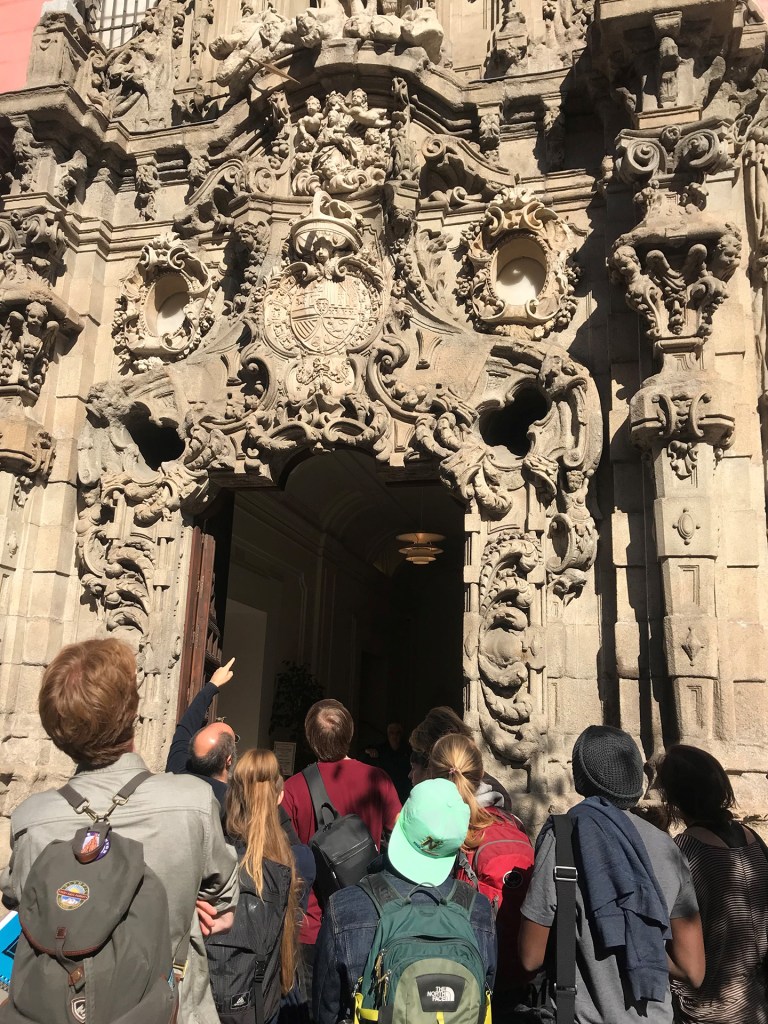
The class admiring Pedro de Ribera’s Baroque style entrance to the Museo de Historia de Madrid.
-Rachel Peterson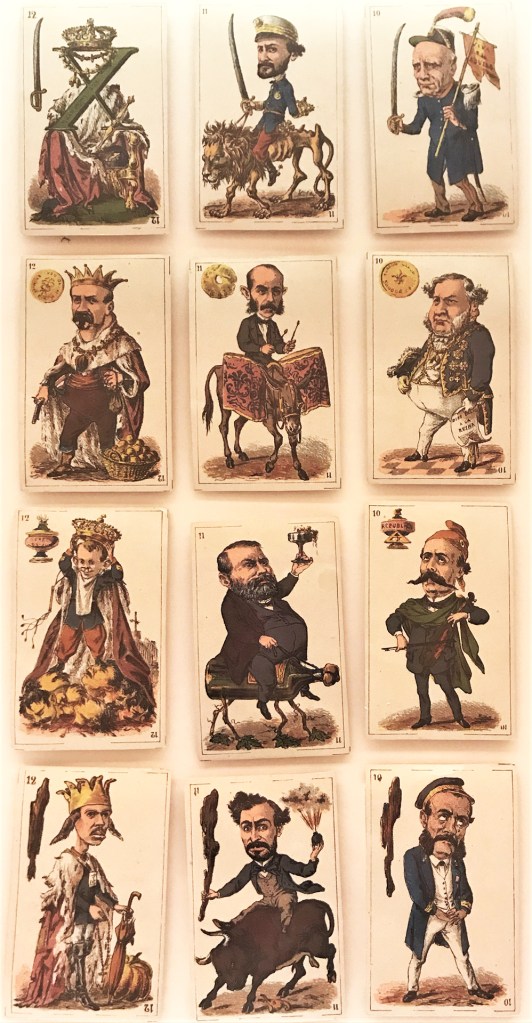
Satirical playing cards of leaders and notable figures.
-Rachel Peterson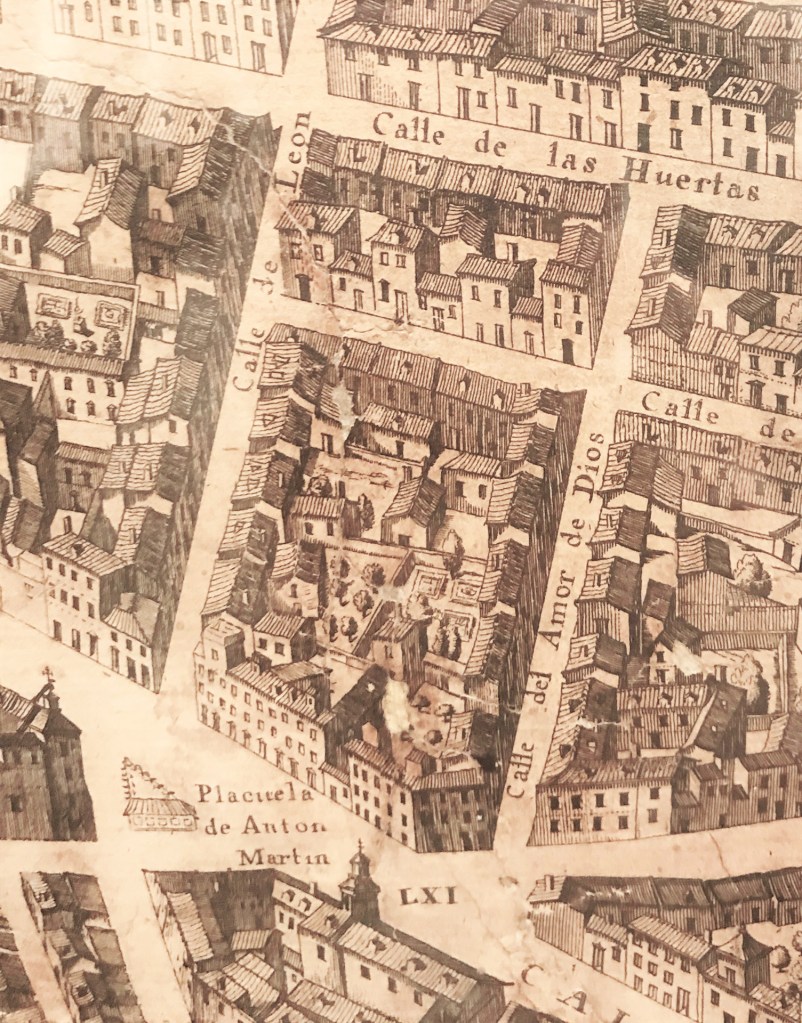
Details of historical hand-drawn Madrid plan.
-Rachel Peterson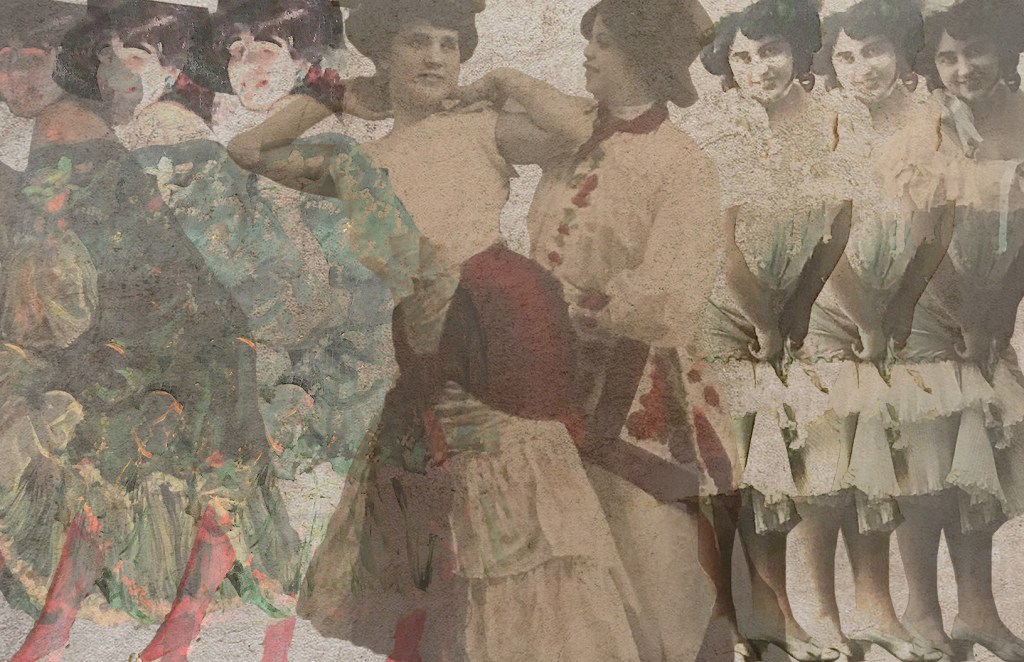
“… the existence of the night-owls and that of the working folk were parallel lives that never for an instant met. For the ones, pleasure, vice, the night; for the others, labour, fatigue, the sun.” – Pio Baroja, The Quest, 1904
-Collage by Rachel Peterson
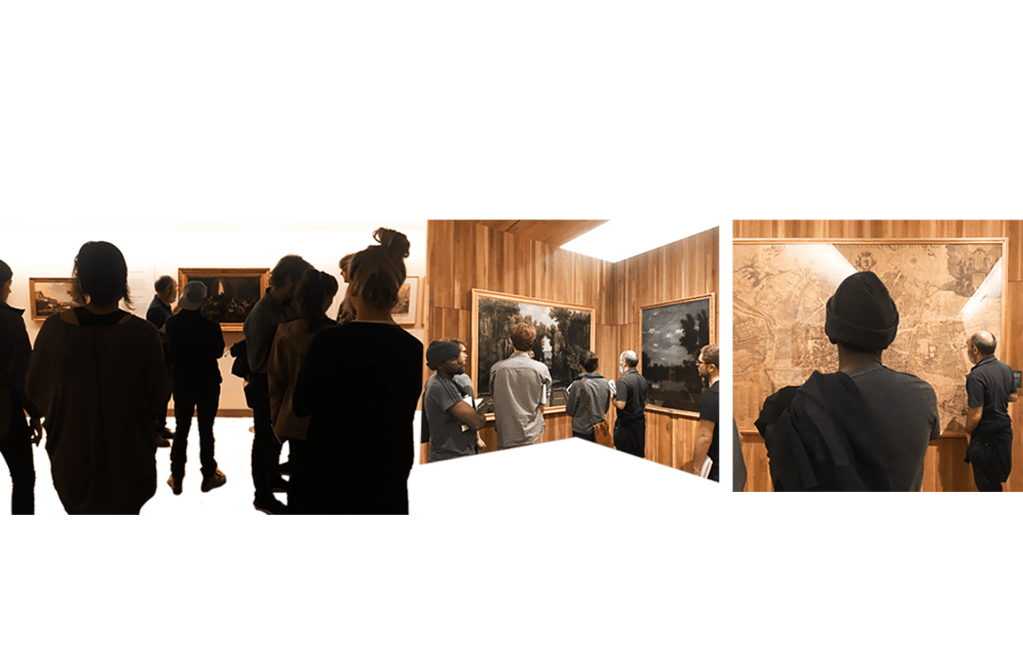
Taking on the Museo de Historia de Madrid piece by piece.
-Kendra Klenz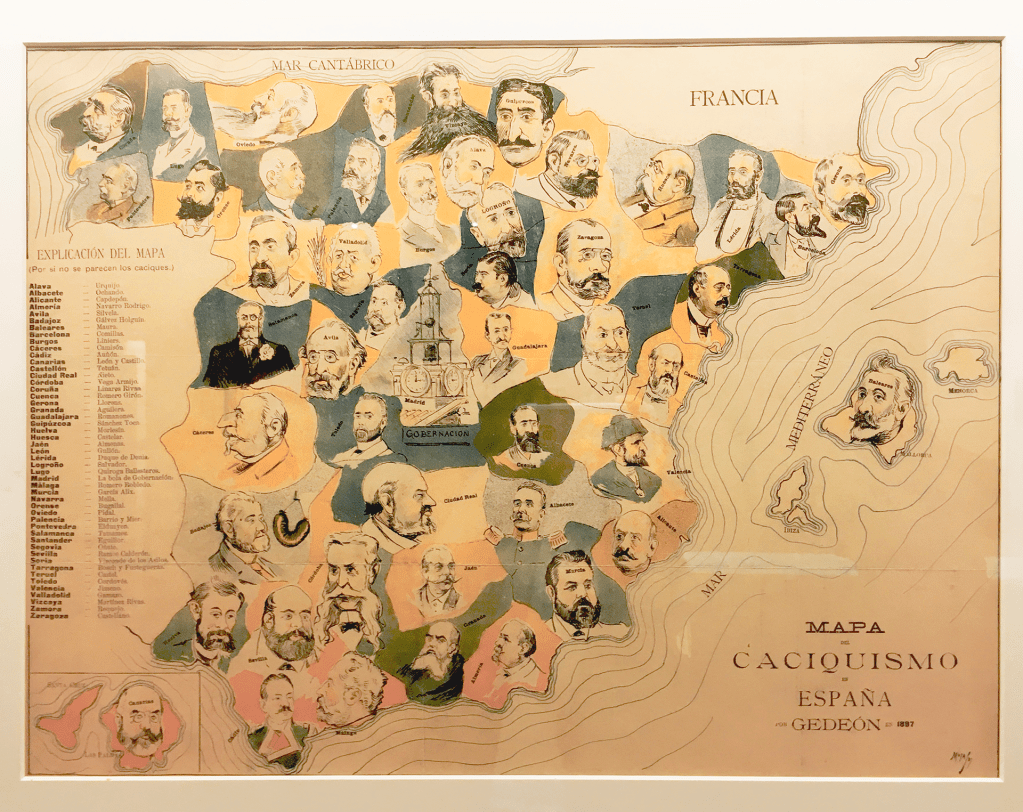
Faces of powerful local government:
Mapa del caciquismo en España (Map of bossism in Spain), Joaquín Moya, 1897
-Kendra Klenz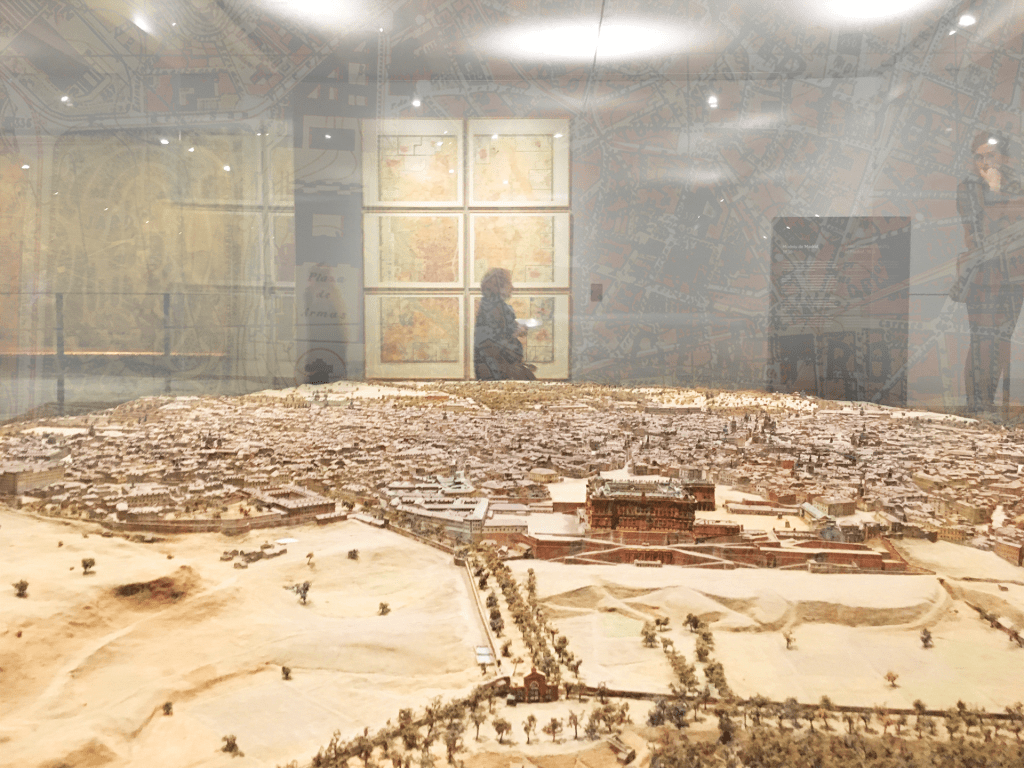
Scale model of Madrid in 1830 designed by military engineer León Gil de Palacio. The model took 23 months to complete.
-Kendra Klenz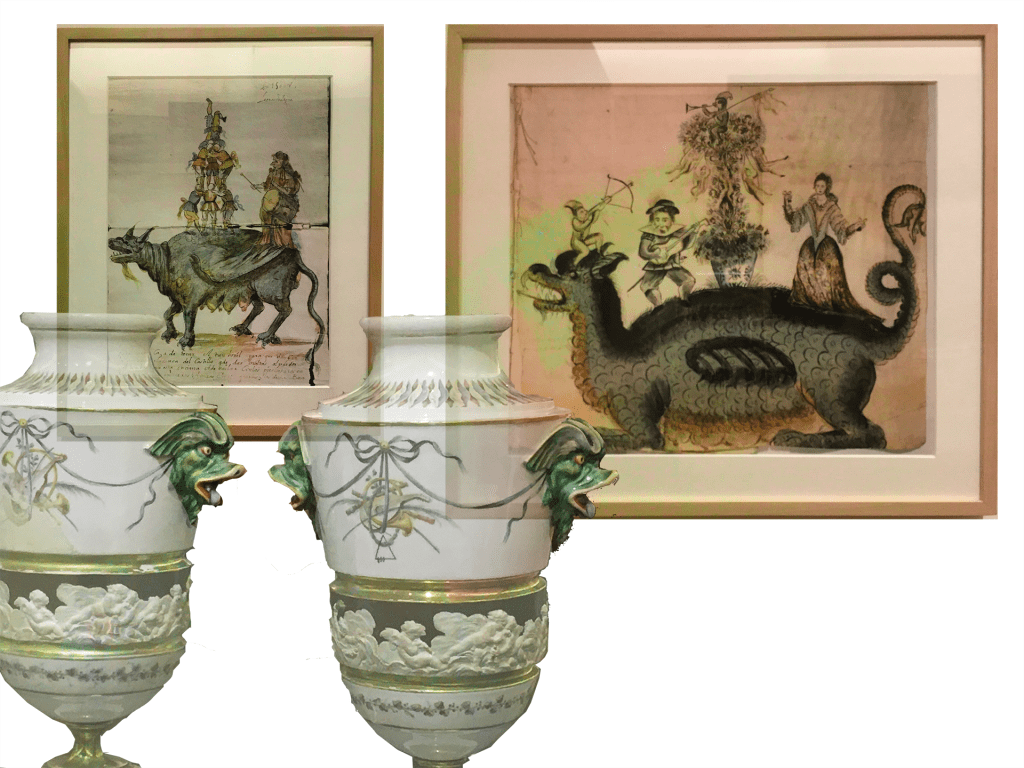
A recurring image: part of court entertainment, especially during carnival in now Buen Retiro Park.
-Kendra Klenz


looks fun
LikeLike